Showing posts with label theatre review. Show all posts

'Antigone' - Review

A review of the July 18, 2012 performance of 'Antigone' (Olivier Theatre, at the National Theatre), by Marianne 
(this review contains spoilers)
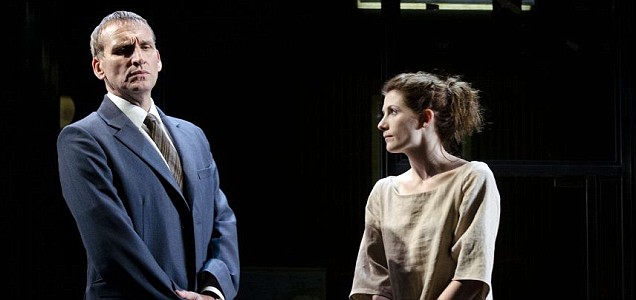

Christopher Eccleston as Creon, Jodie Whittaker as Antigone

As you entered the theater you could already see a couple of actors filing papers, making coffee and chatting. They were moving about an office space consisting of three glass walled rooms, upstage, separated by two corridors; the set allowed characters to easily exit and enter. There were desks, chairs and various office paraphernalia downstage – the equipment was a mixture of pieces from different time periods, giving a feeling of being scrounged. There was no curtain. The design was simple, but very effective, with a bunker feel to it. It gave off an aura of being closed in. The costumes were an interesting mixture of civilian and military clothing, most men wore military boots with their dress shirts and ties. It showed a country in transition, that was not prosperous and balancing on the edge. A portrait of Creon (Christopher Eccleston) in his military uniform, scowling over the whole proceedings, was hanging in his office. The drum revolve, a specific feature of the Olivier (video here), was used effectively to bring the audience outside and inside the city walls. The walls themselves were replicas of the wood textured concrete of the National Theatre exterior.

When you first saw Creon he was wearing his military uniform and, together with members of his 'Cabinet' (the Chorus), watching the killing of an enemy on a monitor. Once the mission was completed, Creon changed into a business suit on stage, with some people assisting him – one of them being his wife Eurydice (Zoë Aldrich). The others took their places within the office space while Creon changed from General to peace time leader. This signified the end of the war and the start of his rule over Thebes. It also emphasized that Creon was a general who was used to commanding soldiers, and not a politician who paid attention to popularity polls and political correctness.

Near the beginning of the play, Creon made a point of addressing his Cabinet. He told them they were all there because he trusted them. I had the feeling that Creon really wanted to make a go of being a good leader. His very visible emotional struggles showed me that he wasn't interested in just dictating to the populace. It wasn't like he was asking for their opinion either, but he did try to get his Cabinet involved. They obviously worked with/for him during the civil war, so they knew what type of man he was, and yet they failed him when he needed them most. Too terrified, pandering or self-serving, they did not seem to know how to make him listen. It was disturbing how easily they turned against him when things started to fall apart. What agenda did they actually have and who were they ultimately serving?

Creon enacted a law that he saw as morally correct and reasonable. He did not want to honor the people who had opposed the ruling government in Thebes, and so denied them any sort of burial. He seemed to be blind to the fact that he was taking his revenge out on the dead, and that the gods might not find favor with that. No member of his Cabinet raised any objections to the new law, despite being also aware of the common citizens' disapproval. Had Creon surrounded himself with "Yes men" who were only comfortable voicing their objections in private and amongst themselves? It would prove to be his downfall.

Three people however tried to convince Creon that he needed to alter his position on burying the war dead. Only the blind seer Teiresias (Jamie Ballard) was able to reach Creon, but after going to extreme measures.

The first one was Antigone (Jodie Whittaker), Creon's niece, the fiancée of his son Haemon and the sister of Polyneices the traitor and Eteocles the hero who were both slain in the war. Antigone's defiance of Creon's law set the events of the play in motion. She seemed determined to commit "suicide by government" when she buried Polyneices making no attempt to hide it. Antigone loved her brother, and felt morally obligated to honor him with proper rites. She believed she served a higher authority than the state of Thebes. Unfortunately, when arrested and brought before Creon for sentencing, she was too busy shouting her righteousness to sit down with him and discuss her misgivings in a constructive way. And Creon could never have backed down to his niece, risking to appear weak, with everyone's eyes on him. I doubt any amount of intervention would have persuaded either party to yield, so convinced they were that each had the moral high ground in their argument. It was as if they were standing on opposite sides of a chasm and there was no middle ground.

Then there's Haemon (Luke Newberry), the son of Creon and Eurydice, engaged to Antigone. Haemon approached Creon in the worst possible way. Their conversation should never have taken place in public either. Haemon spoke to Creon sarcastically and was practically making fun of, and mocking, him. Haemon came off as a whiny boy, desperately in love with his fiancée, unable to communicate with his father on any level. Creon physically subdued Haemon in front of his Cabinet, leaving no doubt as to who the Alpha Male in the household was. This scene was one of the most effective and shocking, but completely believable. It was also a very terrifying example of how violent a man Creon could be.

Creon did not seem to be moved either by Antigone, the Soldier (Luke Norris) or Haemon. Only Teiresias moved Creon, and only after relating to him the prophecy which foretold of his son's death. Hearing that the gods would not look favorably on his edict to leave Polyneices unburied, Creon just glowered at the soothsayer for a long time and then scoffed at the prediction as being motivated by personal gain – the usual shortcoming he saw in people trying to engage with him. Creon had used Teiresias' services during the civil war, and one can assume that without his help Creon would not have survived the conflict and been in a position to rule Thebes. Teiresias' emotional retort to Creon's rejection was absolutely electric. You felt like you were watching a runaway train as it barreled towards the end of the track. Everything after this point happened in quick succession.

In Greek Tragedy deaths always occur off stage, and the production was true to this. I will state that just because you didn't witness the deaths of Antigone, Haemon and Eurydice, it didn't make them any less disturbing or tragic. The way the Messenger (Kobna Holdbrook-Smith) delivered the details of Haemon's and Eurydice's fates was riveting. Creon's descent into despair was completely believable.

The play may be called 'Antigone' but it was really Creon's story. CE was on stage almost the entire time. If he wasn't speaking, he was in his office upstage. The strength of CE's performance was that he played Creon, the villain, not as a monster, but as a human being. As a man motivated not by selfish reasons, but by a belief in the sanctity of the state. It was obvious how much Creon loved his family and his country. The situation that had developed was simply beyond his ability to function in without help. As CE put it, Creon was "drowning" and desperately tried to hide that from everyone. A couple of times you could see him bending over with his head in his hands, obviously struggling with all that was happening to him. He was a leader who made a bad decision, and his inability to change his mind ended up costing him everything he held dear. Creon's grief was palpable, and that was all down to CE's ability to make the audience care about what happened to his character.

All the performances were full of energy even though (or perhaps because) the cast was coming off a fortnight vacation. CE and Jodie Whittaker gave absolutely crackling renditions. They were definitely on their game. I was seated in the back of the stalls and felt very involved in the action. CE had no trouble filling the space and drawing the audience into his acting. He had a distinct presence and commanded the stage.

Creon's soliloquy after bringing Haemon's body in was the emotional highlight of the play, and the final scene will stay with me a long time. It was like an exclamation point at the end of a powerful sentence. Creon's grief was heart wrenching. He left the bunker as the drum revolve rotated to bring the audience outside the city walls one last time. He was covered in his son's blood and was trying to wipe it off. Walking by the city wall, Creon dragged his hand along it leaving a bloody handprint as the play came to an end. Powerful stuff and all done in silence. 

A very effective modern adaptation, and definitely a play you need to discuss after seeing it in order to excise the emotional turmoil you have just experienced.

----------------

Additional production photographs here. Please note that these images are watermarked and contain spoilers.
Main 'Antigone' post.

'Antigone' - Press Night Reviews

Christopher Eccleston as Creon, Jodie Whittaker as Antigone

The Guardian:
Antigone ****-
Christopher Eccleston's outstanding Creon becomes the play's tragic centre. He presents us with a charismatic leader steeped in patriarchal tradition and naively trusting in the invulnerability of power: confronted by Antigone and her sister Ismene, he mockingly observes "these women are neurotic", and when his son Haemon tries to warn him about shifting popular sympathy, he loftily dismisses "the opinions of people in the street". Eccleston's Creon is not evil but fatally in thrall, like many modern politicians, to the idea that authority is somehow inviolable. 

The Guardian:
[...] Antigone – review
Christopher Eccleston's Creon is terrific: a tyrant with a twitch: square in shoulder and jaw, but delivering his speeches with a choppy vigour that suggests anxiety as well as power. The real question he and the production raises is whether this play should be called not Antigone but Creon

The Telegraph:
Antigone, National Theatre ****-
[...] Christopher Eccleston's Creon is the modern, morally-ambivalent politician personified, full of bold conviction until he realises the implications of his dubious strategies.

He superbly captures the growing doubts and panic of the character, but just fails to plumb the depths of tragic despair at the end when he realises he has lost everything that matters and has become a moral void.

The New York Times:
Making a welcome return to the stage, Christopher Eccleston (an erstwhile "Doctor Who" on British television) brings to Creon a stony-faced, sternly spoken command whose granitic resolve crumbles in the face of the reprieve that comes only with death. Jodie Whittaker's Antigone, like Mr. Eccleston, speaks Don Taylor's extant version of the Greek original in her own regional English accent, a shrewd choice accentuating the degree to which these are men and women of the world we know, not remote emissaries from some accursed far-off land.

TimeOutLondon:
Antigone ****-
The keynote is Eccleston's channelling of Tony Blair. It's not an impersonation, but his precise, repetitive diction, mannered body language, cool unflappability and, above all, unshakeable belief in the rightness of his deeply unpopular cause – in this case executing his niece Antigone for defying the law by burying her traitorous brother Polynices – unerringly invokes one man's slippery spirit. It is a superb portrait and critique of the scariest sort of politician: one actually driven by ideology.

The Official London Theatre Guide:
Antigone
Here King Creon, whom Cristopher [sic] Eccleston plays with the measured, unruffled calm of any modern leader, decrees that the cadaver of his treacherous nephew Polynices should be left to slowly rot and be scavenged upon as a lesson in obedience to the state. [...]

While Whittaker's emotion-led Antigone is more likeable than Eccleston's Creon – no-one likes a calm peddler of terror, do they? – his initial arguments are undoubtedly compelling. [...]

[...] it is still Eccleston's Creon who stretches the furthest, those dammed, constricted emotions finally bursting beyond his control as he is left with blood on his hands… and on his clothes… and on the walls…

WhatsOnStage:
Antigone ****-
Creon, played with understated, chilling authority and a Lancastrian accent by Christopher Eccleston, is keen to maintain control after a period of disastrous civil war.

Christopher Eccleston as Creon, Jodie Whittaker as Antigone

Financial Times:
Then Christopher Eccleston enters as Creon.

There is no diplomatic way of putting this: he is Tony Blair. This is nothing so crass as an impersonation, with all those strange, rigid hand gestures. But Eccleston's Creon is driven, like Blair, by a conviction that personal certainty can and should override any amount of popular opposition, and he is similarly unimpassioned in his delivery. [...]

In the final minutes, on receiving the news that his niece Antigone, his son Haemon (who was betrothed to her) and his wife Eurydice are all dead, he unexpectedly cries, "I am nothing!" in the ecstatic roar of the vindicated narcissist. This Creon is a tragic protagonist who fails to learn that it is not all about him.

Exeunt:
[...] Eccleston plays Creon as part bureaucrat, part politician, starting out with the admirable ambition of creating a rule that is about the country, not the man (an antidote to the time of striving brought about by the very personal failings of the fallen king Oedipus); but in his determination to assert himself and his rule, he becomes detached from the very people he is supposed to represent, dismissing their concerns and beliefs in favour of his own flawed judgement. Eccleston beautifully captures the almost casual arrogance of the man, and his disintegration as the repercussions of his decision start to unravel his carefully constructed façade of victory.

Metro:
The rolled-up shirt sleeves of Christopher Eccleston's Creon reminds one of Tony Blair; while an opening sequence recalls the assassination of Osama bin Laden.

Eccleston plays Creon as the consummate modern politician, initially almost reasonable in his absolute conviction that the law should be upheld at any cost. Yet if his Teflon demeanour seems spot-on for our morally ambivalent times, he fails to bring Creon's deeper  personal trajectory into focus.

The Stage Reviews:
Christopher Eccleston's Creon is an upright soldier, convinced that he must make an example of Antigone for the greater good and refusing to listen to pleas from his son, Haemon, who wishes to marry her. He is brutal in condemning Antigone to be executed by being buried alive and, in Findlay's version, exercising control of his son (a slight Luke Newberry) by physical bullying, but he never entirely loses his humanity. His lesson is hard-learned: when his son and wife both kill themselves, he knows he is to blame. A bloodied Eccleston shows him to be broken and distracted.

Theatermania:
Antigone
Christopher Eccleston's intense but measured performance as Creon dominates Polly Findlay's production of Antigone at the Olivier Theatre. [...] 
Eccleston is superb as the new leader whose self-belief and conviction is initially unshakeable. Looking a trifle uneasy in his blue suit, his gestures are precise, his enunciation careful and clear. He is man very aware of how is behavior and actions are perceived; it's a restrained, but potent portrayal, even if he seems unwilling to loosen his grip on his character's sense of propriety and control even at the very end when his hands are stained with the blood of his loved ones and he has lost everything.

London Evening Standard:
Antigone, National Theatre Olivier ****-
The leads, Christopher Eccleston and Jodie Whittaker, suggest the difficulties of reconciling the rule of law with moral duty, and the results are explosive. [...]

Always intense, Eccleston is at his best in a deeply charged scene with his scandalised son Haemon (Luke Newberry).

LondonTheatre:
Antigone ****-
Christopher Eccleston – ex-star of TV's Dr Who – is the hard-nosed King Creon. In spite of his treatment of Antigone, he is more like a bureaucratic businessman than a really menacing, autocratic monarch. There's much of Obama and Blair in Mr Eccleston's performance, and given the subject matter, you can see why.

The Flintshire Chronicle:
Antigone
Elizabeth Wood Bowyer, 15, said: "Antigone was fantastic. It was so interesting to see a legendary play in a modern setting. It really illuminated the connection between ancient and modern politics. The acting was awesome too – Christopher Eccleston was a veritable catacomb of brilliance."

Cast of Antigone

The London Times:
Antigone ****-
This 21st-century interpretation burns particularly hard into our age. Costume and scene remind us of what we know too well in the age of Saddam, Gaddafi and Assad, especially after this week's appalling news from Syria. It's not about togas and robes: superstitious, stubborn, paranoid tyrants whose word is death have suits and ties and CCTV and bustling modern offices, and look just like our own leaders … Eccleston's Creon is the most curious, ultimately gripping performance. At first a chunky crop-haired politico, he seems appropriately wooden and bereft of feeling. But as doubt of his own rightness assails him he warms into vulnerability and madness. In the ghastly triple denouement his "I am nothing! I want nothing! My last, simplest prayer!" rings chill round the great auditorium.


The Sunday London Times:
Christopher Eccleston, as Creon, seems particularly straitjacketed by a colourless interpretation. Dressed in white shirt, tie and grey trousers, he issues his brutal diktats from behind a desk in something like an underground ops room at the Pentagon, surrounded by a posse of paramilitaries.


Express:
Antigone ****-
Yet the production does not have to strain for relevance; it takes it as a given that this is a story about political (dis)order that is always going to speak to us. 
That is amplified in Christopher Eccleston's tense, intense performance as Creon, beautifully showing the cracks in his armour of certainty.

Express:
While minions bustle about on the 20th-century office set, hot desking between piles of paper, Creon (Christopher Eccleston) swaps his army uniform for a sober grey suit in preparation for the post-civil war clean-up campaign until Antigone arrives to challenge his authority and give her brother a decent burial.

The Arts Desk:
Antigone, National Theatre ***--
Eccleston understands this perfectly, dominating the stage by balancing the different public faces required of a politician, yet also being convincing as a family man and as an individual struggling with belief. He also cynically plays the terrorist card.

Spiked:
[...] Creon is accordingly played by a suited Christopher Ecclestone [sic], who is confronted by Jodie Whittaker as an angry young woman. [...] 
The real problem, though, is with Ecclestone's [sic] Creon. He observes many of the tics of a modern statesman, such as removing his jacket to stand arms akimbo while delivering slick speeches pleading political necessity. He is of course also right to reject Tiresias's claim that no one condemns a man who 'recognises his folly and changes'. Everybody knows such men are routinely reviled as shilly-shallying u-turners by political pundits – even if those same pundits also endorse u-turning as fully consultative, authentically pragmatic 'listening'. However, the more fundamental problem with Ecclestone's [sic] Creon is that he is a measured, mannered, distant figure, neither fish nor Führer, blowing neither hot nor cold.  

Seven Magazine:
Sophocles's tale is strong, bloody stuff and Eccleston has what ought to be a dominating role in Creon, the autocratic King of Thebes, who is intent on punishing Antigone (Jodie Whittaker) for the sins of her late brother who has been vanquished in war. 
Don Taylor's adaptation is, alas, set in the present day in what looks like an office somewhere in the north of England. Eccleston – who seems a lot shorter on stage than he does on screen – struts about it in shirtsleeves and eats his packed lunch at his desk. He put me in mind less of a bloody-thirsty tyrant than David Brent on a bad day.

Standpoint:
Creon's defence of his rule is sent up so hammily by Christopher Eccleston that the National's audience tittered at the logic. But this is not Sophocles's point at all. He may, as an enlightened metropolitan Athenian, regard Thebes as a backward place full of retrograde and cruel customs, but he does give Creon an argument for the consistency of state power with a force that foreshadows Hegel's "insight into necessity". That is what makes the play both great and unsettling. 
Eccleston (who played Nicky in Our Friends in the North and one of the sundry Dr Whos) is an intriguing  stage presence, with all the mannerisms of a politician who doesn't quite believe his own logic, and thus says it more loudly.
Christopher Eccleston as Creon, Jodie Whittaker as Antigone

Woman & Home:
Christopher Eccleston is wonderfully understated as the hubristic king, while Jodie Whittaker gives a powerful performance as willful Antigone.

Variety:
Polly Findlay's production of Sophocles' tragedy is set in a Cold War-era bunker, where women in suits pass folders to uniformed army officers; functionaries bend over reel-to-reel tape players; and the man in charge, Creon (Christopher Eccleston), confers with flunkies behind brown-smoked glass. [...] 
Keeping a cool distance from the blood and guts of the story seems to be part of Findlay's reading, or at least affects the way Creon is presented: Even as he confronts his own culpability in the death of his son and wife, Eccleston seems at an emotional remove from the action – his final action is to carelessly smear the blood from his hands onto a wall. Such an interpretation, however, runs against the text and rather negates the purpose of staging it in the first place.

Mail Online:
Dr Who gives Greek tragedy a timely twist ***--
Antigone, By Sophocles: Intense Ecclestone [sic] is the perfect fit ****-
In the Royal National Theatre's pacy new production of Antigone, Creon is played by Christopher Eccleston. He may be best known nationally for his brief stint as TV's Doctor Who but Mr Eccleston is a stage actor of stature.

He combines a rangy physical presence with a temple-twitching intensity.

One of his trademarks is an exaggerated precision in speech, his mouth almost doubling its movements as he delivers the words.

How well this suits Creon as he tussles with his intransigence and confronts the fate imposed on him by merciless gods.

A Younger Theatre:
Jodie Whitaker brings a raw edge and tenacity to Antigone that is often lacking in this character. However, Whitaker's performance stays on one level and never quite spills over with the passion that is required of her – often causing her to underplay the more dramatic moments. I also found Christopher Ecclestone's [sic] Creon to be much the same, something which meant that a rather lengthy dualogue between the two never seemed to reach its climax. 

Bloomberg:
Antigone ***-
Jodie Whittaker makes a stirring and defiant Antigone, standing up for the rights of humanity against temporal laws. If Christopher Eccleston (King Creon) lacks her natural authority, Jamie Ballard gives a wonderfully neurotic turn as the blind prophet Tiresias. This show grips like a fish hook.

City A.M.:
Eccleston plays the tragic king Creon, whose dogged insistence on upholding his principles against the weight of popular and moral opinion – a clash between relativism and objectivism with clear modern parallels – threatens to topple the entire state. But his hubris-driven descent into desperate self-preservation is never quite plausible and Eccleston too often looks a little lost.

'A Doll's House' - Guest Review

2009-08-02 Review of 'A Doll's House' by Hedgehog

Here we go, a somewhat belated review. I’m sorry it took me so long, work kept me.^^

Thanks to a little nudge from our Alex and a sudden "Why the hell not?!"-flash of attitude I found myself boarding a plane with a true masterpiece of a 'plan' (coughs) in my head that can easily be summed up as "Let's get there and see if anything goes if you're really willing to go quite a distance". Back-up plan: London's always worth a visit. And I hadn't been there since 1997 and had been missing this city in a strange way.

To say this trip as a whole has been full of adventures, new insights and ideas and massively re-energizing my depleted batteries would be an understatement. And it was made perfect by how easy it was indeed to get a ticket. I even think I'll stick to doing it the way I did in the future – compared to the experience of queuing, meeting nice and interesting people, bantering with passers-by and cobblestone setters, pre-ordering tickets does seem just boring.

I had read the original play by Ibsen a couple of days before, on the train going home from night shift, so I'd had a bit of comparison. Perhaps to start with that comparison is a good idea (I said it once in the old forum, I'll happily say it again here: I suck at writing reviews, as you are about to see for yourself, hehe.) So here we go.

Basically, what Zinnie Harris has done (imho) is to bring the original play into focus in a way. When I read Ibsen I found there were some parts, especially when there was background explanation on the loaning business, or the 'what happened before'-parts, that were a bit long-ish to read, and thus felt 'blurred'. Harris has managed to reduce said parts to sharp and poignant bare necessities. Something similar happened to the characters, although here the fact the play had been on for some time might factor in as well – see also Alex's second review.

I can best describe what I felt about the characters by using an image: We've got this big cathedral where I'm from, and there are constantly stonemasons at work restoring parts of it – basically they've been doing so since it was built. I used to pass by and get a glimpse of what they were doing, and I remember those old stone figures, contours softened by time and acid rain, standing next to their freshly chiselled newer copies. Similar to this image, the Donmar characters seemed more focused, more sharply carved out as compared to Ibsen's – at least in my perception.

I can't really comment on the changes in language – frankly spoken, it's both English to me. ;-) I'd have to get a script of the Donmar play for a more thorough analysis. Just one thought on those lines of Kelman that didn't go well with some of the critics; to me, they were perfectly fitting. If he's supposed to be a so-called upstart, then of course it's only natural he'd revert to plain language in a situation where he's so being driven into a corner, innit?

It fits right into what I think about those sharpened-out characters, making Kelman seem more like a three dimensional human and less like an artificial character. I only have a general knowledge of literature, but it just wasn't done that way in Ibsen's time – actually writing characters with an accent, or colloquial speech, was it? From what I remember having read at school, even if there was a character that was supposed to be a simple man they always spoke as flawless as those characters of supposedly higher education. Perhaps, if he'd live today, he'd have done it differently himself. Right, I'm starting to drift, so back on topic!

To wrap up this short comparison between original and adaptation, all in all I'd be hard-pressed to find a change I didn't feel to be an improvement or at the very least I found nothing I couldn't live with. It all makes sense in a slightly new way, and yet the original core-content of the play is perfectly preserved. Come to think of it, and if only to say it right in the faces of those critics who have a problem with the adaptation: The generic message, Ibsen's genius and insight, stays perfectly preserved. (I wonder if it was for the likes of such critics would we still be waiting for a lucky coincidence during a thunderstorm to get our meals cooked? Sorry, turning off *snarky-mode* now…)

The biggest change in my opinion, and as far as I'm concerned the only one that really changed something is the position from which Kelman starts off as compared to Krogstad's original point. The latter one still sees a chance to prevent bad things from happening to him, blackmailing Nora to keep his post. The former, however, has already been confronted with his career having been smashed to pieces. Or, to put it differently, Krogstad is threatened with a disaster about to happen for him (pretty much like Nora, should he carry out his threat and tell her husband about the loan), Kelman however has already arrived in the middle of the disaster, and can do nothing but fight to keep from drowning completely.

A thought that just occurred to me when writing this last paragraph – it changes the character, so logically, he has a different name. Following that line of thought – while Nora and Rank kept their names, they also are the characters that stay close to Ibsen's original version. Mrs. Linde has definitely changed, too, and has been consequently renamed to Lyle. And what about Torvald/Thomas? My original comment, typically simple-minded as I am, was "Torvald is boring, Thomas at least has now become a more real character". In truth, I just have a strong aversion to that kind of man, so my subconsciousness probably simply opted to ignore Torvald but couldn't escape Thomas.

About the change from Krogstad to Kelman, I believe it helps to make his three-and-a-bit appearances less staccato-like, although I can't help but wonder how it would've looked if they'd gone the opposite way… Krogstad, not being knee-deep in shit from the very beginning, does start out somewhat darker and more villainous than Kelman. It's easier to condemn Krogstad for using the dishonourable means of blackmail seemingly just to keep a position than Kelman, who makes very clear from the start he's at least doing so for a good cause, caring for his kids.

However, considering the short time of the play this opposite way might have been over the edge, sort of. What doesn't change is him being both a main catalyst to the whole story as well as going through a development of his own. And on the so said to be sharp and sudden end of Kelman's story, that much I have to say, even if I promised myself not to go there – that's how it happens in real life. Trust me, I've been there. I applaud Ibsen for knowing this, and also for his insight about 'absolute certainty'. 'nuff said.

As for the acting, I seem to be in accordance with the general consensus (for once in my life, eh) – absolutely brilliant. If you're interested I'll elaborate on the single characters, but for the sake of keeping this review within something at least remotely resembling boundaries I shall restrain myself here.

When I re-met with some of the people I'd met earlier in the queue during the break, I think the most eloquent opinion they got from me was "wow"… and frankly I'm still having trouble getting beyond that. No matter which language I'm trying to put it in. My brain knows I can't talk with Mach-1-speed, and neither can I type fast enough to keep up with my thoughts. I still wish I'd have had an extra pair of eyes and ears, though. Taking it all in what happens on the stage, what happens with the audience (and I really enjoyed that experience), it's different in a place such as the Donmar, where everything is a bit more cuddly than my usual row-25-need-looking-glass-and-hearing-aid-seat.

So, there's a play I can relate to personally in so many ways (but a review isn't the place to go there), there's a stellar performance by the cast – what more could you possibly ask for? I say it once again, Alex, thanks for your encouragement – I went, I saw and I came back with sensory perception overflow and a bag full of thoughts, a bit (or more) wiser and richer than I was before.

*tongue in cheek* So: "Wow", to sum it up.

'A Doll's House' - One Month Later - Review

2009-06-29 We don't lie down easily either, so here are some further thoughts on 'A Doll's House' and Chris Eccleston's Kelman.

Seeing the play a bit more than a month into its run was almost a completely new experience. The play lost its fragility and acquired three-dimensional presence, homogeneity and rhythm. The actors allowed themselves from time to time to move their characters off the beaten path, in other words, the play that has been taking its first steps when I saw it in the beginning, has truly come alive.

There have been made some changes about Kelman's costume. First of all, he no longer wears the coat in the first act. Probably it gives him further mobility, but it also neutralises the effect of his appearance, especially the very first gloomy one. It can though also be seen as introducing the character further in its arc, i.e. now completely leaving his strength or composure behind, and offering an extremely flimsy base for the menacing act he puts up for Nora later.

(I already had the thought before, and it was strengthened by this change, that Kelman was about to go Jude's way. Yes, he lives just round the corner, but he's the only one walking around inappropriately dressed for winter, not to speak about his third scene.)

Another addition to costume is that he wears braces hanging down skinhead-like in that third scene. This final touch completes his image as a savage to such a degree that one cannot even begin questioning his language - he's so gone, it's not worth trying to find a politician in him; it's a fight to stay a sane human being that's foremost. And the contrasting arguments, what he tells - or spits out - about his life, ambitions, family, it's not sentimentality, it's just crude words of mass-produced obituary.

All this doesn't make him seem out of place, on the contrary, it lends him credibility. One can see how this determined man was knocked down by the sudden terrible shift of events. To call Kelman one-dimensional would mean ignoring all his plight and treating him as a common thug. And that's the last thing he is, even if he's not totally straight. He is indeed a man drowning, as Christine explains, also: 'He makes things worse for himself, he's like a snake in a trap, thrashing around.'

It should be noted, Eccleston variates how he plays each night, perhaps most of all actors. It's not just the usual modifying of intonation, stress, cadence, but also the whole physical presence, his position on stage - the only moments where it's locked is when he directly interacts with others. Speaking of interaction, his tussle with Nora has become much more violent, where it's more of a norm than an accident that both end up on the floor (not just kneeling as before). What's unchanging, is his smiles that are beyond unnerving. No need to wield a bicycle chain.

And this leaves us with the quiet fourth scene. Here it's not the changes in the performance - which are much slighter too, - but my deeper understanding of the play having seen it more than once or twice, having read the playtext, that made it different. For one, it's how Christine is constantly established as the rescuer of the dispossessed through all her appearances, that she is in a stage of her life where she tries to rebuild herself, and - live. Then, Kelman is obviously completely alone. There's his typist, who helps him, but in no way is in a position to do more than warn him. And that's it. Everyone else is queueing to dance on his grave.

Seen in this light, the conclusion is much less sudden. And for London Evening Standard reviewer who wondered how come Christine couldn't find Neil before, the play offers some clues: Kelman has changed his name; Christine is just emerging from the ruins of her past - it was her who had left him; she survived unloved husband, started shaping her life anew. If her and Neil's paths hadn't crossed at this point, she might have sought him out once she had achieved stability - she's a strong and proud woman who kept her heart.

To conclude, I must say I'm impressed with the play's development, and while I'm still not ready to call it perfect, it's gained strength, and where it's been occasionally treading lightly, it has now fully established itself. I'm especially glad to have witnessed one particular evening, which, banally speaking, was an example of theatre magic. It was easy flowing, things clicked into their places seemingly effortlessly, actors looked laid-back and enjoying it as much as the audience, and that was also when Eccleston provided one of his extra-inspired performances.

- - - - - - - - -

You can find other 'A Doll's House' related posts via this directory.

'A Doll's House' - Review Talk-back


As of today, the new play 'A Doll's House' has garnered 25 online reviews. There are two things the critics seem to agree about: Great performances (of the whole cast or a selected actress/actor, especially Gillian Anderson), but questionable adaptation (with the full spectrum of positive and negative nuances).

While one can argue about the serendipity of the excessive topicality given the recent development in the political circles of Great Britain, other points seem quite artificial.
For example The Guardian remarks that Kelman's (Chris Eccleston) language is inconsistent with the Edwardian period, and many a reviewer quotes one of his utterances to support this claim.

Why not look from the other side? Wouldn't it be ludicrous to say that Zinnie Harris, British, professional, experienced writer, could have been unable to historically anchor the language of her work? That she cannot tell one period from another? It is obvious that this is a deliberate choice, because the text is consistent, doesn't jump from one style to another, and, even more importantly, it's not only in the form, but also in what the characters say: Note what Kelman tells about his life to Nora.

Then, Kelman's character. The Guardian: "[...] I could hardly believe in Kelman as an Edwardian politician [...]" or The British Theatre Guide: "However, his demeanour would make him an unlikely political bigwig in any era, let alone the late Victorian period." First of all, this is not a science fiction scenario. One can rather easily imagine Neil Kelman fighting his way up, elbowing a lot of wrong people in the process, gaining his position, but never - allies, staying an outsider, an upstart.

Eventually he gets corrupted - because of deceased ideals or bowing under the strain of hardships, unhappy family life, unhealthy atmosphere at the top. And his mistake, not really of massive proportions, is immediately utilized to kick him, this hated weasel, out. Enter Thomas Vaughan, well-connected, well-established, probably with multiple generations of politicians behind him.

Discrepancies, also as slight period variations from character to character, can be treated as faults. On the other hand, it's more than just convenient to look at the rewrite as a palimpsest. While one can hear modern words, one looks through the time at the historical set and costumes. And the layers of playing - are these the characters as they see themselves, is it their representation, independent from time and space?

Variety maintains: "But his [Kelman's] D.H. Lawrence manner and language ("I'd still have your husband by the testicles") seem too modern and wildly unlikely for a successful politician." How exactly does 'a successful politician' threaten his rival's wife? And he's not that successful, is he? It's also very important that one only observes the relations between characters while they're 'back-stage', i.e. at home, in private, among acquaintances. And combined with the possible development, described above, Kelman's demeanour is absolutely plausible.

Finally, directly speaking, one can treat such critics' comments as pure racism. It appears that the fight for 'all regions' high culture is not a matter of the times past. This might be an exaggeration, but would Kelman's place in Edwardian times (and actor's in the play) have been questioned to such an extent, if he was played by a black actor?

Of course, there are other points that ring true - for example about a missing step between Kelman's second and third acts' scenes, despite Eccleston's exploring performance, but overall the adaptation is highly original, and it's a pity that some find it difficult to stop comparing it to Ibsen, trying to identify as many weaknesses as possible, instead of listening to the new message it carries.

'A Doll's House' - Press Night Reviews I

Neil KelmanChris Eccleston as Neil Kelman

Aye

Daily Express:

A Doll's House ****-
Christopher Eccleston gives what must surely be one of the performances of his life as the villainous, blackmailing Kelman. He has the advantage of a roaring voice and his very height – well over six feet – only adds to the terror he instils in the hapless Nora.
Culturevulture:
A Doll's House
Chistopher Eccleston's menacing blackmailer Kelman is hugely effective and his scenes with Nora are electric. His taunts are not merely threatening but arise from a bitterness and despair at being trapped in a political scandal he cannot get out of. He is desperate to be re-instated because of his two young sons, therefore making his course of action understandable. He also conveys the loneliness of the widower and his reignited passion for Christine and subsequent restored humanity (another tricky transition) are vividly believable in his hands.
What's On Stage:
A Doll's House ****-
Anderson and Stephens - a devilishly handsome couple they make, too - are bravely complemented by Christopher Eccleston's bitterly vengeful Lancastrian Kelman and Anton Lesser’s vulpine, bespectacled Dr Rank [...]
Theatermania:
A Doll's House
As Kelman, Eccleston supplies a measure of menace and an unnerving volatility. Yet, there is also something poignant in his desperation; he is a 'man drowning' as Tara Fitzgerald's Christine puts it.
TheatreguideLondon:
A Doll's House
The finest performances of the evening are those of Tara Fitzgerald as Nora's confidante and Christopher Eccleston as the villain. Both carry a solid reality with them from the moment they step on stage, making the scenes they are in the most involving and resonant. Eccleston in particular avoids the waiting dangers of moustache-twirling villainy and Uriah Heep crawling to create an ordinarily imperfect man in desperate straits.

The strongest emotional moments in the play are not between Nora and her husband, but the one in which the bad guy threatens Nora and the later reconciliation of the former lovers played by Eccleston and Fitzgerald.
Curtain Up:
A Doll's House
Christopher Eccleston's Kelman, on the other hand, is unexpectedly affecting and sympathetic. His performance as the rogue, disgraced politician, is full of intense desperation and is at once angry and vulnerable.
Here Is The City:
The Donmar's Doll's House
The parallel story of Christine and Neil (Tara Fitzgerald and Christopher Eccleston), again beautifully portrayed in their pain and longing for love, is very poignantly different in that the miracle does happen. A 'bad' man changes through being loved. Are we to think that change is easier when you are not part of the establishment? That you can access your heart and your humanity so much more easily when you have less to lose?
Reviews Gate:
A Doll's House
There is also fine work from Tara Fitzgerald as an uncommonly strong Christine and Christopher Eccleston’s catalystic rough diamond and fallen politician, Neil Kelman.
musicOMH:
A Doll's House
****-
Christopher Eccleston gives Kelman an air of desperation as well as menace as someone who seems to have lost all sense of self-worth until offered unexpected redemption by former lost love Christine.
Time Out:
A Doll's House
****--
Eccleston’s politician has a driving force; he looks like he's stormed anachronistically in from the set of 'Spooks'.
The Mail on Sunday (May 24, 2009):
Gillian's the perfect Doll
****-
Christopher Eccleston has terrific edge as the blackmailing oik Neil Kelman who is healed by the love of a good woman (an excellent Tara Fitzgerald). Theirs will be a marriage of equals.
Neil and NoraNeil Kelman and Nora (Gillian Anderson)

The Independent:
First Night: A Doll's House, The Donmar, London ***-- (20/5)
A Doll's House, Donmar Warehouse, London ****- (21/5)
Does that explain why Zinnie Harris has translated her new version from late 19th century Norway to Edwardian London in 1909 and shifted the tale of intrigue, fraud and betrayal from the world of finance to that of politics?

It's only a partially successful transposition, and lines like: "I've got him by his testicles," sound distinctly odd, even when uttered by former Doctor Who Christopher Eccleston, full of ire and splutter as Neil Kelman, a Lancastrian politician hastily removed from office after certain "allegations" and a huge falling out with the PM.
It's worth noting the superb playing of Eccleston and Tara Fitzgerald (once a fine Nora herself at the Birmingham Rep) as his true love, Mrs Lyle (Mrs Lynde in Ibsen), and Nora's best friend, in the sub-plot recipe for a slightly more ideal marriage.
BBC News:
Scully meets Doctor in Ibsen play
Eccleston's role is a minor one by comparison, though he convincingly portrays a desperate man fighting for survival in his relatively brief appearances.
Theater News Online:
A Fragrant Happenstance
But the real sexual charge here is not generated between Nora and her husband, but the vengeful and blackmailing disgraced politician Kelman played by a terrificly fevered Christopher Eccleston. The scene during which he threatens Nora with ruin has a torrid edge. And tellingly, theirs is the only relationship without deception.
Financial Times:
A timely take on hypocrisy ****-
The production is beautifully acted. Anton Lesser is a fine, watchful Dr Rank, and there are strong performances from Tara Fitzgerald as Nora's worldly-wise friend and Christopher Eccleston as the dubious creditor.
Theatremonkey:
A Doll's House
Christopher Eccleston has a hard time living up to the current sleaze levels expected of politicians, but rises admirably to the occasion [...]
Sunday Express (May 24, 2009):
Political Masterpiece
*****
Christopher Eccleston is creepily insinuating as the creditor, trying to use the debt to rescue his own career.
Mail Online:
Another house, another scandal *****
Kelman is Thomas's political enemy. He has fallen out with the prime minister. He is fighting for his career. Christopher Eccleston may not have intended this but he plays him just like Alan Milburn, complete with Geordie accent and open-mouthed contempt, tongue flicking against the side of his cheeks as he saunters around the stage with menace.

Television viewers will remember Mr Eccleston as the actor who preceded David Tennant as Doctor Who (jolly good he was, too). Here he creates a rangy, feral chancer who melts at the first sign of affection being shown to him.

Maybe the capitulation is a little sudden, but he is an intriguing intruder who invades the Christmastide domestic bliss of Nora and Thomas's grace-and-favour home, complete with its endearing children.
The Guardian:
A Doll's House ***--
[...] if Kelman is really guilty of fraud, you wonder how on earth he can hope to return to the political arena. And when at one point he cries: "I've screwed the Vaughans," you feel his language is hardly consistent with the period.
And even though I could hardly believe in Kelman as an Edwardian politician, Christopher Eccleston lends him the right anguished aggression.
Telegraph:
A Doll's House, at the Donmar Warehouse - review ***--
[...] and there is strong support from Tara Fitzgerald as Nora's tough-minded friend, Christopher Eccleston as the bad egg she finally redeems and Anton Lesser [...]

Part II: ? & Nay
Neil and Christine
Kelman and Christine (Tara Fitzgerald)

'A Doll's House' - Press Night Reviews II


Kelman and Nora. Neil Kelman

Part I: Aye

?

The British Theatre Guide:
A Doll's House
The couple's nemesis is former Doctor Who Christopher Eccleston, playing Neil Kelman. This rough Lancastrian is supposed to be a senior MP who has just lost his job to Thomas after the revelation of an unstated financial scandal. However, his demeanour would make him an unlikely political bigwig in any era, let alone the late Victorian period.
Under the direction of Kfir Yefet, Miss Anderson only gets into top gear in an explosive final scene, while Christopher Eccleston is also at his best when storming around.
Official London Theatre Guide:
First Night Feature: A Doll's House
A Doll's House is also about love. Christine, the drably-dressed, penniless widow who married for money, believes in it. Kelman, after raging against Nora with an imposing physicality, is softened by it. But where love should be – in a marriage which has borne two young children – there is only its image.
Variety:
A Doll's House
Ibsen's money-lending Krogstad is now Kelman, a wildly aggrieved politician, himself accused of fraud, who has been supplanted by Thomas. Kicking over a chair and slamming a book against the wall of designer Anthony Ward's handsome oval room, Christopher Eccleston bristles with end-of-his-tether desperation. But his D.H. Lawrence manner and language ("I'd still have your husband by the testicles") seem too modern and wildly unlikely for a successful politician.

Helmer Yefet is clearly intent upon delineating everyone's defining characteristics. But underlining can lead to undermining. Eccleston's rage is so fully stated -- again, too little for audiences to discover -- that his transition to grateful lover of Tara Fitzgerald's nicely pinched but similarly blunt Christine feels implausible.
Times Online. The Times:
A Doll's House at Donmar Warehouse, WC2 ***--

Times Online. The Sunday Times:
A Doll's House at Donmar Warehouse, WC2 ****-

The Independent on Sunday:
A Doll's House, Donmar, et al.

Chris Eccleston and Gillian Anderson in 'A Doll's House'

Nay

The Observer:
A Doll's House, et al.
Christopher Eccleston, the blackmailer who is here an ousted politician, is unremittingly ferocious, and Tara Fitzgerald unstintingly bleak as the poor friend. No one has more than one character line to follow. Everyone is emphatic, and that lowers the voltage.
London Evening Standard:
A Doll's House has a modern agenda ***--
It seems absurd, too, that Christine should have considered Kelman the love of her life but had no idea of a way to find him. How hard can it have been to track down a Cabinet minister in 1909? None of this detracts from the performances, which are impressive.

As Nora, Gillian Anderson is poised and affecting. Fitzgerald is subtle. Eccleston, though miscast, exudes virile menace [...]
Spectator:
Playing Ibsen For Laughs
Christopher Eccleston has hysterics twice and throws the furniture around. Lots of rage, not much range.
Londonist:
Theatre Review: A Doll's House @ the Donmar Warehouse
But it was Christopher Eccleston we were eager to see. He played the disgraced MP Neil Kelman (Krogstad from the original) as that same manic Mancunian he seems to be hired to do these days; all flared nostrils, bared teeth, hands pulling desperately through his Hitler-esque haircut. He was excellent, but we were longing to see him do something a bit different.
The Stage:
A Doll's House
Eccleston's Kelman, here an MP whose career has been destroyed in the wake of fraud allegations, is appropriately out of place. His thick Manchester accent a pewter tankard among the cut-glass voices of the rest of the cast. But this extends to his relationship with the audience. He plays him brash and punchy but there is at no time any sympathy for the character and he fails to generate a third dimension. Not even when Tara Fitzgerald, as the widowed Christine, declares her love for the man she might have saved from breaking. Christine is a stiff old maid, whose life has made her elderly before her time, and while Fitzgerald lets her warm heart beat through, the declaration of love for Kelman never quite rings true. It gives the final act of the play a slightly cobbled together feel.
The London Paper:
Theatre review of Ibsen's A Doll's House at Donmar Warehouse ****-
Eccleston's Kelman lacks sufficient menace, flailing around like an aggressive scarecrow [...]

'A Doll's House' - Review

Today (2009-05-14) Alex saw the first performance (a preview) of 'A Doll's House' with Gillian Anderson and Chris Eccleston at Donmar Warehouse and provides the following review. (Some spoilers might have sneaked in, if you've never read the play.)

The Set-up
London, 1909. Nora and Thomas have just moved house after he was promoted. They still live out of boxes and are still getting to grips with the changes. Both the house and Thomas' new political post previously belonged to Neil Kelman (Eccleston), who, despite shady accusations, will not surrender while there's still hope he and his career might be rescued.

Nora finds herself between the three men - her husband, wanting her to just play the role of a politician's wife, his property; Dr. Rank, a ghost of days past, faithful to her; Kelman, a desperate man, who eventually forces her out of the fake role-playing and empowers her to make decisions. Being looked at differently by all three of them, she must make up her mind how she looks at herself.

The Adaptation
Though the action has been transplanted to a new environment, changes aren't deep (i.e., they are functional, but not ruled by the new setting; topical, but not historical). The slightly unexpected aspect of the piece was that it is often funny, especially with Toby Stephens' (Thomas) somewhat exaggerated performance, making me think of Eddie Izzard, and comic relief moments with macaroons, heavily implying a parallel to drug addiction. Gillian Anderson was definitely impressive, being both playful and spunky, a woman who can think and dares make choices, for better or worse. Another great performance - bias or no bias - was from Eccleston.

Eccleston as Kelman
He has four scenes: short introductory and a big scene expounding the conflict between Kelman and Nora in the first act, another big one with Nora in the second and finally the scene with Christine in the third. In the first act he's sharply dressed, wears a dark suit and black coat and appears really menacing, like concentrated darkness. His smiles are cold, and his threats feel tangible.

The second act's appearance is a very obvious contrast - he comes in from the rain, unstable, perhaps intoxicated (on the second night it was more of a tragic funk), his clothes in disarray. He's physically intimidating and the energy really simmers.

The Characterisation
Replying to another review about whether Eccleston's portrayal of a politician is realistic, I realised that Kelman actually reminds of Nicky Hutchinson, idealistic in his youth, then getting corrupted by hardships of life. And Thomas who has a great dislike of his concurrent, might have his own reasons to treat Kelman like an upstart: While you can clearly picture generations of high rang politicians in Thomas' family history, Neil must have fought his way up.

Kelman, in big contrast to Nora's husband, speaks to her as to his equal, even if he threatens - he doesn't look down on her. And while he threatens, terrorises her, he's still vulnerable, because he does need her help. He doesn't shun any means, but he's a proud man, he feels that life has dealt him an unlucky hand, and he doesn't deserve the way people treat him. He still thinks of honour, and it's a juxtaposition to Thomas, who's playing a more standard family head, more flashy, more of a twat.

The Conclusion
Kelman is cracking up and distraught. Still, eventually it makes it possible for him to shed his shell, carve away the grime that has accumulated on his soul and start anew. As a concept it sounds good, but in reality it's a pity that this adaptation stayed true to the original in the end, and Kelman's final scene, with Christine, I found just as pathetic as when I read it (the main difference to, again, 'Our Friends In The North' being that Nicky's decision was personal, and had no effect on anyone else or his professional career).

The ending does no justice to Neil in my mind, because it feels like a retreat from author's side, having established this man, not without faults, but still fighting his fight and healthier thinking, sans the sleazy selfishness of Thomas, and then making him suddenly happy with unconditional love and flesh. Perhaps I shouldn't see it as a defeat, but it comes across as more cruel than having him succumb after his career is ruined.

And it does no justice to Eccleston, who otherwise fed masses of energy into his character, balancing him, and was believable and consistent throughout.

A Doll's House (May 14th & 15th): 7/10, no doubt it will find its rhythm and pace: As seen on the second night, the play is alive and started developing.
CE: 9/10.

- - - - - - - - -

Debate continues with a talk-back for the critics' reviews here and a new review after seeing the play again here.

Pictures ©Donmar Warehouse