Showing posts with label theatre. Show all posts

'Now That You've Died'

2013 Aug 9
Play by Patrick Ness
Directors: Hector Harkness & Kate Hargreaves
Role: Narrator
Venue: The Roundhouse, London


Support RNIB and make more books available to the blind and partially sighted


Audio:


Listen to the audio of the show (save link as to download) - more info - please support RNIB by way of thanks.
Also part of The Guardian's podcast (including discussion with Patrick Ness).


Video:


Interview with Christopher Eccleston


Behind the scenes


Extras:

"Every year RNIB hammers home the message that more books need to be made accessible to blind people. The campaign is called Read For RNIB. This year the charity pulled out all the stops to raise awareness – as Insight Radio's Leeanne Coyle found out."
Includes extracts and the after the show message
Here's the video script of the latter, kindly provided by RNIB.
Congratulations, you made it.

I'm Chris Eccleston. I am sure all you want to do now is sit down, relax and have a nice cup of tea. And don't worry; you will have that opportunity in just a few minutes time.

But first I need you to listen for just a while longer to understand why you've been invited here today by Royal National Institute of Blind People.

You've just experienced something quite unique, a book without words, a story without reading, a play performed in total darkness. The point is that a story is about much more than just the words on a page. Today you have experienced reading in a whole new way.

In the UK there are almost two million people who are blind or partially sighted, and the sad fact is, their choice of books is significantly more limited than it is for sighted people. Just seven per cent of all books are fully accessible for them.

I find it hard to imagine what my life would be like without being able to access books and scripts or enjoy a bedtime story with my little boy. For many blind and partially sighted people, reading is even more important, it can be a lifeline. It's the key to helping them live independently as part of an inclusive society.

You probably aren't aware but RNIB's National Library Service sends out millions of books every year in braille, giant print and in talking book audio format.

But it's not just about Talking Books – RNIB provides so much more. It has a team which transcribes everything from newspapers and magazines such as OK! Magazine and National Geographic. It even provides sheet music and instructions for game boards.

RNIB works with the publishing industry to increase the number of books that are accessible, and with the eBook industry to make sure that new technology isn’t limited to people who can see.

And that's what Read for RNIB Day is all about. Raising money and awareness to help RNIB continue this important work and to provide guidance to the 100 people who today will have embarked on their own sight loss journey.

Now is your opportunity to take action and support Read for RNIB Day on Friday October 11. We need you to use your influence today to help us spread the word; tweet about this experience, share with your friends, colleagues and audiences, blog to your hearts content, encourage everyone across Britain to visit the website and get involved.

RNIB can currently only reach one in three people who need it most – help us change that story and open up a world of reading for blind and partially sighted people.

Thank you.

Help Us Change The Story. Read For RNIB Day. 11th October.


Articles:


'Antigone' - NT Discover Theatre Series

National Theatre's iTunesU Greek theatre resources

NT Discover Theatre on Youtube:

An Introduction to Greek Tragedy (video link)
This film explores the defining aspects of Greek tragedy and why the plays resonate with audiences today. Featured in this film are experts Edith Hall, professor of Classics at Kings College, London, Laura Swift from the Open University and Dr Sean McElvoy from Varndean College, Brighton.

An Introduction to Greek Theatre (video link) 
This film explores the defining aspects of Greek Theatre. The theatre of Ancient Greece flourished between 550 BC and 220 BC. A festival honouring the god Dionysus was held in Athens, out of which three dramatic genres emerged: tragedy, comedy and the satyr play.

'Antigone': An Introduction (video link)
This film offers a brief introduction to Aristotle's theory of tragedy from Edith Hall, before introducing the play 'Antigone' by Sophocles. Polly Findlay speaks about her interpretation of Don Taylor's translation of 'Antigone' for the National Theatre's Olivier theatre in 2012. This short film includes interviews with Christopher Eccleston, Jodie Whittaker and Michael Grady-Hall as well as excerpts of archive footage from the 2012 production.

'Antigone': The Ancient Greek Chorus (video link)
This film offers a brief introduction to the Ancient Greek Chorus from Edith Hall, before Polly Findlay speaks about her contemporary interpretation of the chorus in Don Taylor's translation of 'Antigone' for the National Theatre's Olivier theatre in 2012. This short film contains interviews with dramaturg Ben Power and actor Michael Grady-Hall as well as excerpts of archive footage from the 2012 production.

'Antigone': Creon and Antigone (video link)
Creon has outlawed the burial of Polynices but Antigone, believing that God's law is above state law, chooses to ignore this and is punished. This relationship is made more complicated as Creon is Antigone's uncle and she is betrothed to his son Haemon. This film features interviews with Christopher Eccleston (Creon), Polly Findlay (Director) and Jodie Whittaker (Antigone) and archive footage from the 2012 National Theatre production.

'Antigone': Haemon and Antigone (video link)
In this film Luke Newberry talks about the character of Haemon and looks at how his relationship with Antigone adds tension to his relationship with Creon. This video includes archive footage from the 2012 production of 'Antigone'.

'Antigone': Religion and Modern Context (video link)
This video looks at the role of religion in 'Antigone' and how this resonates with the modern interpretation in Polly Findlay's 2012 production. This video features interviews with Polly Findlay (Director), Michael Grady-Hall (Chorus) and Jodie Whittaker (Antigone), and archive footage from the 2012 production.

'Antigone': Family versus State (video link)
This film looks at a central conflict within the play; Creon's belief in State weighed against the actions of his family. This video features interviews with Christopher Eccleston, Polly Findlay and Jodie Whittaker and includes archive footage from the 2012 production.

'Antigone': Creon and Haemon (video link)
Haemon is the last of Creon's three sons and this played an important role in the 2012 production of 'Antigone'. In this video Christopher Eccleston discusses how Creon's loss affected the relationship between Creon and Haemon.


'Antigone': Heightened Language (video link)
Ancient plays are often problematic because of their use of language, director Polly Findlay talks about her approach to this in the 2012 production of 'Antigone'. This video includes archive footage of the performance and interviews with Christopher Eccleston, Michael Grady Hall and Kobna Holdbrook-Smith.


'Antigone' - Review

A review of the July 18, 2012 performance of 'Antigone' (Olivier Theatre, at the National Theatre), by Marianne 
(this review contains spoilers)


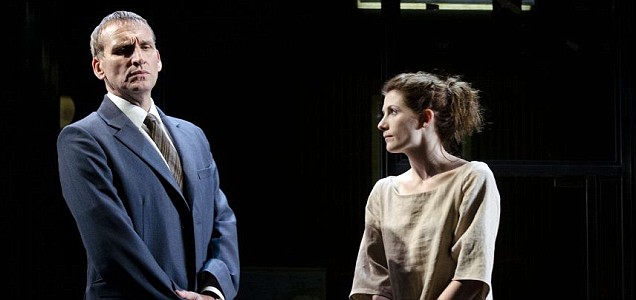
Christopher Eccleston as Creon, Jodie Whittaker as Antigone

As you entered the theater you could already see a couple of actors filing papers, making coffee and chatting. They were moving about an office space consisting of three glass walled rooms, upstage, separated by two corridors; the set allowed characters to easily exit and enter. There were desks, chairs and various office paraphernalia downstage – the equipment was a mixture of pieces from different time periods, giving a feeling of being scrounged. There was no curtain. The design was simple, but very effective, with a bunker feel to it. It gave off an aura of being closed in. The costumes were an interesting mixture of civilian and military clothing, most men wore military boots with their dress shirts and ties. It showed a country in transition, that was not prosperous and balancing on the edge. A portrait of Creon (Christopher Eccleston) in his military uniform, scowling over the whole proceedings, was hanging in his office. The drum revolve, a specific feature of the Olivier (video here), was used effectively to bring the audience outside and inside the city walls. The walls themselves were replicas of the wood textured concrete of the National Theatre exterior.

When you first saw Creon he was wearing his military uniform and, together with members of his 'Cabinet' (the Chorus), watching the killing of an enemy on a monitor. Once the mission was completed, Creon changed into a business suit on stage, with some people assisting him – one of them being his wife Eurydice (Zoë Aldrich). The others took their places within the office space while Creon changed from General to peace time leader. This signified the end of the war and the start of his rule over Thebes. It also emphasized that Creon was a general who was used to commanding soldiers, and not a politician who paid attention to popularity polls and political correctness.

Near the beginning of the play, Creon made a point of addressing his Cabinet. He told them they were all there because he trusted them. I had the feeling that Creon really wanted to make a go of being a good leader. His very visible emotional struggles showed me that he wasn't interested in just dictating to the populace. It wasn't like he was asking for their opinion either, but he did try to get his Cabinet involved. They obviously worked with/for him during the civil war, so they knew what type of man he was, and yet they failed him when he needed them most. Too terrified, pandering or self-serving, they did not seem to know how to make him listen. It was disturbing how easily they turned against him when things started to fall apart. What agenda did they actually have and who were they ultimately serving?

Creon enacted a law that he saw as morally correct and reasonable. He did not want to honor the people who had opposed the ruling government in Thebes, and so denied them any sort of burial. He seemed to be blind to the fact that he was taking his revenge out on the dead, and that the gods might not find favor with that. No member of his Cabinet raised any objections to the new law, despite being also aware of the common citizens' disapproval. Had Creon surrounded himself with "Yes men" who were only comfortable voicing their objections in private and amongst themselves? It would prove to be his downfall.

Three people however tried to convince Creon that he needed to alter his position on burying the war dead. Only the blind seer Teiresias (Jamie Ballard) was able to reach Creon, but after going to extreme measures.

The first one was Antigone (Jodie Whittaker), Creon's niece, the fiancée of his son Haemon and the sister of Polyneices the traitor and Eteocles the hero who were both slain in the war. Antigone's defiance of Creon's law set the events of the play in motion. She seemed determined to commit "suicide by government" when she buried Polyneices making no attempt to hide it. Antigone loved her brother, and felt morally obligated to honor him with proper rites. She believed she served a higher authority than the state of Thebes. Unfortunately, when arrested and brought before Creon for sentencing, she was too busy shouting her righteousness to sit down with him and discuss her misgivings in a constructive way. And Creon could never have backed down to his niece, risking to appear weak, with everyone's eyes on him. I doubt any amount of intervention would have persuaded either party to yield, so convinced they were that each had the moral high ground in their argument. It was as if they were standing on opposite sides of a chasm and there was no middle ground.

Then there's Haemon (Luke Newberry), the son of Creon and Eurydice, engaged to Antigone. Haemon approached Creon in the worst possible way. Their conversation should never have taken place in public either. Haemon spoke to Creon sarcastically and was practically making fun of, and mocking, him. Haemon came off as a whiny boy, desperately in love with his fiancée, unable to communicate with his father on any level. Creon physically subdued Haemon in front of his Cabinet, leaving no doubt as to who the Alpha Male in the household was. This scene was one of the most effective and shocking, but completely believable. It was also a very terrifying example of how violent a man Creon could be.

Creon did not seem to be moved either by Antigone, the Soldier (Luke Norris) or Haemon. Only Teiresias moved Creon, and only after relating to him the prophecy which foretold of his son's death. Hearing that the gods would not look favorably on his edict to leave Polyneices unburied, Creon just glowered at the soothsayer for a long time and then scoffed at the prediction as being motivated by personal gain – the usual shortcoming he saw in people trying to engage with him. Creon had used Teiresias' services during the civil war, and one can assume that without his help Creon would not have survived the conflict and been in a position to rule Thebes. Teiresias' emotional retort to Creon's rejection was absolutely electric. You felt like you were watching a runaway train as it barreled towards the end of the track. Everything after this point happened in quick succession.

In Greek Tragedy deaths always occur off stage, and the production was true to this. I will state that just because you didn't witness the deaths of Antigone, Haemon and Eurydice, it didn't make them any less disturbing or tragic. The way the Messenger (Kobna Holdbrook-Smith) delivered the details of Haemon's and Eurydice's fates was riveting. Creon's descent into despair was completely believable.

The play may be called 'Antigone' but it was really Creon's story. CE was on stage almost the entire time. If he wasn't speaking, he was in his office upstage. The strength of CE's performance was that he played Creon, the villain, not as a monster, but as a human being. As a man motivated not by selfish reasons, but by a belief in the sanctity of the state. It was obvious how much Creon loved his family and his country. The situation that had developed was simply beyond his ability to function in without help. As CE put it, Creon was "drowning" and desperately tried to hide that from everyone. A couple of times you could see him bending over with his head in his hands, obviously struggling with all that was happening to him. He was a leader who made a bad decision, and his inability to change his mind ended up costing him everything he held dear. Creon's grief was palpable, and that was all down to CE's ability to make the audience care about what happened to his character.

All the performances were full of energy even though (or perhaps because) the cast was coming off a fortnight vacation. CE and Jodie Whittaker gave absolutely crackling renditions. They were definitely on their game. I was seated in the back of the stalls and felt very involved in the action. CE had no trouble filling the space and drawing the audience into his acting. He had a distinct presence and commanded the stage.

Creon's soliloquy after bringing Haemon's body in was the emotional highlight of the play, and the final scene will stay with me a long time. It was like an exclamation point at the end of a powerful sentence. Creon's grief was heart wrenching. He left the bunker as the drum revolve rotated to bring the audience outside the city walls one last time. He was covered in his son's blood and was trying to wipe it off. Walking by the city wall, Creon dragged his hand along it leaving a bloody handprint as the play came to an end. Powerful stuff and all done in silence. 

A very effective modern adaptation, and definitely a play you need to discuss after seeing it in order to excise the emotional turmoil you have just experienced.

----------------

Additional production photographs here. Please note that these images are watermarked and contain spoilers.
Main 'Antigone' post.

'Antigone' - Press Night Reviews

Christopher Eccleston as Creon, Jodie Whittaker as Antigone

The Guardian:
Antigone ****-
Christopher Eccleston's outstanding Creon becomes the play's tragic centre. He presents us with a charismatic leader steeped in patriarchal tradition and naively trusting in the invulnerability of power: confronted by Antigone and her sister Ismene, he mockingly observes "these women are neurotic", and when his son Haemon tries to warn him about shifting popular sympathy, he loftily dismisses "the opinions of people in the street". Eccleston's Creon is not evil but fatally in thrall, like many modern politicians, to the idea that authority is somehow inviolable. 

The Guardian:
[...] Antigone – review
Christopher Eccleston's Creon is terrific: a tyrant with a twitch: square in shoulder and jaw, but delivering his speeches with a choppy vigour that suggests anxiety as well as power. The real question he and the production raises is whether this play should be called not Antigone but Creon

The Telegraph:
Antigone, National Theatre ****-
[...] Christopher Eccleston's Creon is the modern, morally-ambivalent politician personified, full of bold conviction until he realises the implications of his dubious strategies.

He superbly captures the growing doubts and panic of the character, but just fails to plumb the depths of tragic despair at the end when he realises he has lost everything that matters and has become a moral void.

The New York Times:
Making a welcome return to the stage, Christopher Eccleston (an erstwhile "Doctor Who" on British television) brings to Creon a stony-faced, sternly spoken command whose granitic resolve crumbles in the face of the reprieve that comes only with death. Jodie Whittaker's Antigone, like Mr. Eccleston, speaks Don Taylor's extant version of the Greek original in her own regional English accent, a shrewd choice accentuating the degree to which these are men and women of the world we know, not remote emissaries from some accursed far-off land.

TimeOutLondon:
Antigone ****-
The keynote is Eccleston's channelling of Tony Blair. It's not an impersonation, but his precise, repetitive diction, mannered body language, cool unflappability and, above all, unshakeable belief in the rightness of his deeply unpopular cause – in this case executing his niece Antigone for defying the law by burying her traitorous brother Polynices – unerringly invokes one man's slippery spirit. It is a superb portrait and critique of the scariest sort of politician: one actually driven by ideology.

The Official London Theatre Guide:
Antigone
Here King Creon, whom Cristopher [sic] Eccleston plays with the measured, unruffled calm of any modern leader, decrees that the cadaver of his treacherous nephew Polynices should be left to slowly rot and be scavenged upon as a lesson in obedience to the state. [...]

While Whittaker's emotion-led Antigone is more likeable than Eccleston's Creon – no-one likes a calm peddler of terror, do they? – his initial arguments are undoubtedly compelling. [...]

[...] it is still Eccleston's Creon who stretches the furthest, those dammed, constricted emotions finally bursting beyond his control as he is left with blood on his hands… and on his clothes… and on the walls…

WhatsOnStage:
Antigone ****-
Creon, played with understated, chilling authority and a Lancastrian accent by Christopher Eccleston, is keen to maintain control after a period of disastrous civil war.

Christopher Eccleston as Creon, Jodie Whittaker as Antigone

Financial Times:
Then Christopher Eccleston enters as Creon.

There is no diplomatic way of putting this: he is Tony Blair. This is nothing so crass as an impersonation, with all those strange, rigid hand gestures. But Eccleston's Creon is driven, like Blair, by a conviction that personal certainty can and should override any amount of popular opposition, and he is similarly unimpassioned in his delivery. [...]

In the final minutes, on receiving the news that his niece Antigone, his son Haemon (who was betrothed to her) and his wife Eurydice are all dead, he unexpectedly cries, "I am nothing!" in the ecstatic roar of the vindicated narcissist. This Creon is a tragic protagonist who fails to learn that it is not all about him.

Exeunt:
[...] Eccleston plays Creon as part bureaucrat, part politician, starting out with the admirable ambition of creating a rule that is about the country, not the man (an antidote to the time of striving brought about by the very personal failings of the fallen king Oedipus); but in his determination to assert himself and his rule, he becomes detached from the very people he is supposed to represent, dismissing their concerns and beliefs in favour of his own flawed judgement. Eccleston beautifully captures the almost casual arrogance of the man, and his disintegration as the repercussions of his decision start to unravel his carefully constructed façade of victory.

Metro:
The rolled-up shirt sleeves of Christopher Eccleston's Creon reminds one of Tony Blair; while an opening sequence recalls the assassination of Osama bin Laden.

Eccleston plays Creon as the consummate modern politician, initially almost reasonable in his absolute conviction that the law should be upheld at any cost. Yet if his Teflon demeanour seems spot-on for our morally ambivalent times, he fails to bring Creon's deeper  personal trajectory into focus.

The Stage Reviews:
Christopher Eccleston's Creon is an upright soldier, convinced that he must make an example of Antigone for the greater good and refusing to listen to pleas from his son, Haemon, who wishes to marry her. He is brutal in condemning Antigone to be executed by being buried alive and, in Findlay's version, exercising control of his son (a slight Luke Newberry) by physical bullying, but he never entirely loses his humanity. His lesson is hard-learned: when his son and wife both kill themselves, he knows he is to blame. A bloodied Eccleston shows him to be broken and distracted.

Theatermania:
Antigone
Christopher Eccleston's intense but measured performance as Creon dominates Polly Findlay's production of Antigone at the Olivier Theatre. [...] 
Eccleston is superb as the new leader whose self-belief and conviction is initially unshakeable. Looking a trifle uneasy in his blue suit, his gestures are precise, his enunciation careful and clear. He is man very aware of how is behavior and actions are perceived; it's a restrained, but potent portrayal, even if he seems unwilling to loosen his grip on his character's sense of propriety and control even at the very end when his hands are stained with the blood of his loved ones and he has lost everything.

London Evening Standard:
Antigone, National Theatre Olivier ****-
The leads, Christopher Eccleston and Jodie Whittaker, suggest the difficulties of reconciling the rule of law with moral duty, and the results are explosive. [...]

Always intense, Eccleston is at his best in a deeply charged scene with his scandalised son Haemon (Luke Newberry).

LondonTheatre:
Antigone ****-
Christopher Eccleston – ex-star of TV's Dr Who – is the hard-nosed King Creon. In spite of his treatment of Antigone, he is more like a bureaucratic businessman than a really menacing, autocratic monarch. There's much of Obama and Blair in Mr Eccleston's performance, and given the subject matter, you can see why.

The Flintshire Chronicle:
Antigone
Elizabeth Wood Bowyer, 15, said: "Antigone was fantastic. It was so interesting to see a legendary play in a modern setting. It really illuminated the connection between ancient and modern politics. The acting was awesome too – Christopher Eccleston was a veritable catacomb of brilliance."

Cast of Antigone

The London Times:
Antigone ****-
This 21st-century interpretation burns particularly hard into our age. Costume and scene remind us of what we know too well in the age of Saddam, Gaddafi and Assad, especially after this week's appalling news from Syria. It's not about togas and robes: superstitious, stubborn, paranoid tyrants whose word is death have suits and ties and CCTV and bustling modern offices, and look just like our own leaders … Eccleston's Creon is the most curious, ultimately gripping performance. At first a chunky crop-haired politico, he seems appropriately wooden and bereft of feeling. But as doubt of his own rightness assails him he warms into vulnerability and madness. In the ghastly triple denouement his "I am nothing! I want nothing! My last, simplest prayer!" rings chill round the great auditorium.


The Sunday London Times:
Christopher Eccleston, as Creon, seems particularly straitjacketed by a colourless interpretation. Dressed in white shirt, tie and grey trousers, he issues his brutal diktats from behind a desk in something like an underground ops room at the Pentagon, surrounded by a posse of paramilitaries.


Express:
Antigone ****-
Yet the production does not have to strain for relevance; it takes it as a given that this is a story about political (dis)order that is always going to speak to us. 
That is amplified in Christopher Eccleston's tense, intense performance as Creon, beautifully showing the cracks in his armour of certainty.

Express:
While minions bustle about on the 20th-century office set, hot desking between piles of paper, Creon (Christopher Eccleston) swaps his army uniform for a sober grey suit in preparation for the post-civil war clean-up campaign until Antigone arrives to challenge his authority and give her brother a decent burial.

The Arts Desk:
Antigone, National Theatre ***--
Eccleston understands this perfectly, dominating the stage by balancing the different public faces required of a politician, yet also being convincing as a family man and as an individual struggling with belief. He also cynically plays the terrorist card.

Spiked:
[...] Creon is accordingly played by a suited Christopher Ecclestone [sic], who is confronted by Jodie Whittaker as an angry young woman. [...] 
The real problem, though, is with Ecclestone's [sic] Creon. He observes many of the tics of a modern statesman, such as removing his jacket to stand arms akimbo while delivering slick speeches pleading political necessity. He is of course also right to reject Tiresias's claim that no one condemns a man who 'recognises his folly and changes'. Everybody knows such men are routinely reviled as shilly-shallying u-turners by political pundits – even if those same pundits also endorse u-turning as fully consultative, authentically pragmatic 'listening'. However, the more fundamental problem with Ecclestone's [sic] Creon is that he is a measured, mannered, distant figure, neither fish nor Führer, blowing neither hot nor cold.  

Seven Magazine:
Sophocles's tale is strong, bloody stuff and Eccleston has what ought to be a dominating role in Creon, the autocratic King of Thebes, who is intent on punishing Antigone (Jodie Whittaker) for the sins of her late brother who has been vanquished in war. 
Don Taylor's adaptation is, alas, set in the present day in what looks like an office somewhere in the north of England. Eccleston – who seems a lot shorter on stage than he does on screen – struts about it in shirtsleeves and eats his packed lunch at his desk. He put me in mind less of a bloody-thirsty tyrant than David Brent on a bad day.

Standpoint:
Creon's defence of his rule is sent up so hammily by Christopher Eccleston that the National's audience tittered at the logic. But this is not Sophocles's point at all. He may, as an enlightened metropolitan Athenian, regard Thebes as a backward place full of retrograde and cruel customs, but he does give Creon an argument for the consistency of state power with a force that foreshadows Hegel's "insight into necessity". That is what makes the play both great and unsettling. 
Eccleston (who played Nicky in Our Friends in the North and one of the sundry Dr Whos) is an intriguing  stage presence, with all the mannerisms of a politician who doesn't quite believe his own logic, and thus says it more loudly.
Christopher Eccleston as Creon, Jodie Whittaker as Antigone

Woman & Home:
Christopher Eccleston is wonderfully understated as the hubristic king, while Jodie Whittaker gives a powerful performance as willful Antigone.

Variety:
Polly Findlay's production of Sophocles' tragedy is set in a Cold War-era bunker, where women in suits pass folders to uniformed army officers; functionaries bend over reel-to-reel tape players; and the man in charge, Creon (Christopher Eccleston), confers with flunkies behind brown-smoked glass. [...] 
Keeping a cool distance from the blood and guts of the story seems to be part of Findlay's reading, or at least affects the way Creon is presented: Even as he confronts his own culpability in the death of his son and wife, Eccleston seems at an emotional remove from the action – his final action is to carelessly smear the blood from his hands onto a wall. Such an interpretation, however, runs against the text and rather negates the purpose of staging it in the first place.

Mail Online:
Dr Who gives Greek tragedy a timely twist ***--
Antigone, By Sophocles: Intense Ecclestone [sic] is the perfect fit ****-
In the Royal National Theatre's pacy new production of Antigone, Creon is played by Christopher Eccleston. He may be best known nationally for his brief stint as TV's Doctor Who but Mr Eccleston is a stage actor of stature.

He combines a rangy physical presence with a temple-twitching intensity.

One of his trademarks is an exaggerated precision in speech, his mouth almost doubling its movements as he delivers the words.

How well this suits Creon as he tussles with his intransigence and confronts the fate imposed on him by merciless gods.

A Younger Theatre:
Jodie Whitaker brings a raw edge and tenacity to Antigone that is often lacking in this character. However, Whitaker's performance stays on one level and never quite spills over with the passion that is required of her – often causing her to underplay the more dramatic moments. I also found Christopher Ecclestone's [sic] Creon to be much the same, something which meant that a rather lengthy dualogue between the two never seemed to reach its climax. 

Bloomberg:
Antigone ***-
Jodie Whittaker makes a stirring and defiant Antigone, standing up for the rights of humanity against temporal laws. If Christopher Eccleston (King Creon) lacks her natural authority, Jamie Ballard gives a wonderfully neurotic turn as the blind prophet Tiresias. This show grips like a fish hook.

City A.M.:
Eccleston plays the tragic king Creon, whose dogged insistence on upholding his principles against the weight of popular and moral opinion – a clash between relativism and objectivism with clear modern parallels – threatens to topple the entire state. But his hubris-driven descent into desperate self-preservation is never quite plausible and Eccleston too often looks a little lost.

'Antigone'

Christopher Eccleston as Creon
2012
Previews from: 23 May
Opening Night: 30 May
Closing Night: 21 July (extended)
Play
by Sophocles in a version by Don Taylor
Director:
Polly Findlay
Role: Creon, King of Thebes
Venue:
National Theatre, Olivier Theatre
Cast


Playtext (transl. by F. Storr) --- NT page (tickets available)

"Jodie Whittaker plays Antigone and Christopher Eccleston her uncle, Creon, in this thrilling contemporary staging of Sophocles' great drama.
Desperate to gain control over a city ravaged by war, Creon refuses to bury the body of Antigone's rebellious brother. Outraged, she defies him and Creon condemns the young woman to be buried alive." NT


Reactions:

• Press Night (May 30th) online and newspaper reviews (w/ pictures from the play)

• Blog Reviews:
Prof. Whitestick (blog, July 26), sueyuk (blog, July 17), Poly Gianniba (blog, July 5), Naima Khan (blog, July 5), Working Breakfast (Tumblr blog, July 4), Rachel Mariner (blog, Jun 26), Liz Gloyn (blog, Jun 21), TheRestrictedReviewer (blog, Jun 21), garethjames (blog, Jun 20), Louise (blog, Jun 19), Hugh Alford (blog, Jun 18), Unique Cafe (blog, Jun 18), TheRestrictedReviewer (blog, Jun 13), Webcowgirl (blog, Jun 13), West End Whingers (blog, Jun 12), nextdramaticstep (blog, Jun 12), Miranda's Island (blog, Jun 11), Lou Reviews (blog, Jun 11), alicelsmith (blog, Jun 11), Geoff Morley (blog, Jun 11), Red Reviews (Tumblr blog, Jun 10), neptunienne (Tumblr blog, Jun 9), nikkimusingsandthoughts (blog, Jun 9), Unrestricted Views (blog, Jun 9), Katie Toms (blog, Jun 5), GirlReporter (blog, Jun 5), Matt Trueman (blog, Jun 5), Everything Theatre (blog, Jun 4), byronic (Tumblr blog, Jun 3), PlatformPieces (blog, Jun 2), nick730 (blog, Jun 1), Edith Hall (blog, Jun 1), Jonathan Taylor, son of Don Taylor (blog, May 30), Dotty (blog, May 30), Mark Ronan (blog, May 30)

• Pre-Press Night Reviews:
A Civilian's Guide to the Theatre (blog, May 29), Jonathan Evens (blog, May 29), MissP (blog, May 28), Rachel (blog, May 25), Hamsterfur (Tumblr blog, May 24), Finn Pollard (blog, May 24), Eastendlass (blog, May 23), TheRestrictedReviewer (blog, May 23), Ian (blog, May 23)

• Radio Reviews:
Jun 15 The Arts Show, BBC Radio 2 - site iPlayer 
Jun 2 Saturday Review, BBC Radio 4 - site iPlayer
May 31 Front Row, BBC Radio 4 - site - iPlayer - download podcast (mp3; save target/link as)
May 30 Philip Dodd - Night Waves, BBC Radio 3 - site - iPlayer

• Marianne's review - July 18


Interviews:

• July 19 VIDEO National Theatre - In Conversation With Christopher Eccleston (streaming - video download, iTunes)
• May 16 The Telegraph - Christopher Eccleston interview: "This is why I became an actor"


Additional Materials:

 NT Discover Theatre Series - 'Antigone' - a collection of workpacks and videos on the subject of Greek Theatre, including interviews with the cast and clips from 'Antigone';
 LondonTheatre.co.uk - eleven production photos; 


News:

• Nov 25 London Evening Standard Theatre Awards 2012 - Winners - Winners include Soutra Gilmour, Best Design.

• Oct 29 London Evening Standard Theatre Awards 2012 - Longlist - Nominees include Polly Findlay, Best Director and Soutra Gilmour, Best Design.

The Times Cheltenham Literature Festival: L065 Christopher Eccleston and Polly Findlay - They join us here to discuss this extraordinary production of a remarkable play, and why Sophocles' moral debate is timeless. Oct 7 - info and tickets.

• Jun 1 BBC News - Antigone: Four star reviews for Christopher Eccleston; WhatsOnStage - A chorus of approval for Findlay's Antigone. (review round-ups)

AUDIO TheatreVoice - Director Polly Findlay explores the tragedy of Antigone.

• May 19 Loose Ends, BBC Radio 4 - Clive Anderson Attacks The Block with actress Jodie Whittaker, who's about to perform the title role of Antigone at London's National Theatre.

May 9 'Antigone' rehearsal photos on National Theatre's Facebook page.


Apr 10 'Antigone' rehearsals start today. (tweet; source)

In Conversation With Christopher Eccleston - An afternoon interview, talking to Al Senter about his current role in 'Antigone' and his career, and answering your questions. July 19 - info and tickets.

Director Polly Findlay will discuss her production of Sophocles' play on Jun 1 - info and tickets.

Feb 10 2012 Christopher Eccleston has been cast as Creon, King of Thebes in 'Antigone':
Desperate to gain control over a city ravaged by civil war, Creon refuses to bury the body of Antigone's rebellious brother. Outraged, she defies his edict. Creon condemns the young woman, his niece, to be buried alive.

He can't forbid me to love my brother. He has neither the right, nor the power, to do that.


The people daren't object but the prophet Teiresias warns that this tyranny will anger the gods: the rotting corpse is polluting the city.

There is no gag like terror, is there, gentlemen?

Creon hesitates and his fate is sealed.

The gods never move faster than when punishing men with the consequences of their own actions.

Cast:


Antigone - Jodie Whittaker
Creon - Christopher Eccleston
Eurydice - Zoë Aldrich
Teiresias - Jamie Ballard
Haemon - Luke Newberry
Messenger - Kobna Holdbrook-Smith
Soldier - Luke Norris

Theatre - Eccleston Cast in 'Antigone'

2012-2-10 Christopher Eccleston has been cast as Creon in the National Theatre's 'Antigone' (Sophocles), with Jodie Whittaker and directed by Polly Findlay.

The National Theatre:

Desperate to gain control over a city ravaged by civil war, Creon refuses to bury the body of Antigone's rebellious brother. Outraged, she defies his edict. Creon condemns the young woman, his niece, to be buried alive.

He can't forbid me to love my brother. He has neither the right, nor the power, to do that.

The people daren't object but the prophet Teiresias warns that this tyranny will anger the gods: the rotting corpse is polluting the city.

There is no gag like terror, is there, gentlemen?

Creon hesitates and his fate is sealed.

The gods never move faster than when punishing men with the consequences of their own actions.

'Antigone' opens May 23 and runs until Jun 20. Tickets for general public available from Feb 15.
Also, the director Polly Findlay will discuss her production of Sophocles' play Jun 1 - info.


Main 'Antigone' post