Showing posts with label report. Show all posts

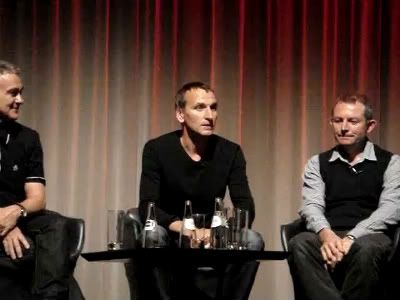
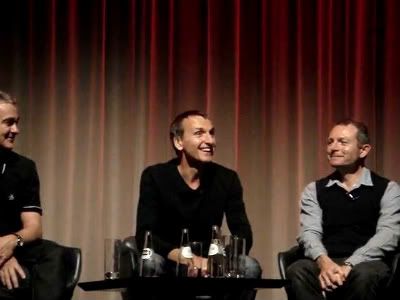
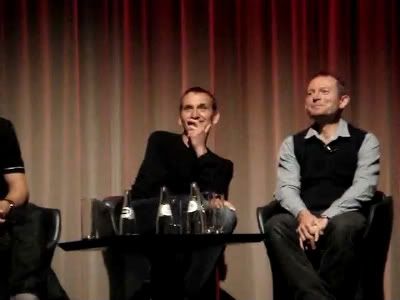
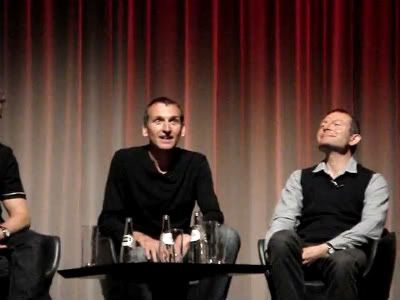
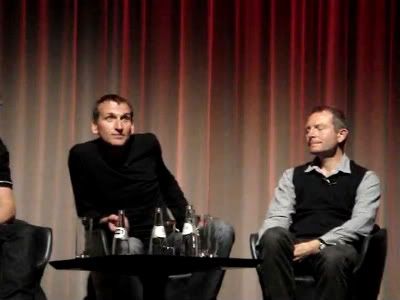
Christopher Eccleston - Masterclass - Report

2011-7-23

Images by Stuart Allen / Masterclass TRH

Theatre Royal Haymarket, London, July 20
By Jen and Alex

The setting: Very ornate theatre; house lights were only slightly dimmed, so both sides could see each other. A chair (for Eccleston) and a side table (for a bottle of water) were set in the middle of the stage which had a nice false perspective background.
The audience: Mixed, but predominantly youthful – questions were asked by pupils, drama students, young professionals.

Christopher Eccleston started with a brief introduction, mentioning, not without some amusement, that he had just come back from South Africa where he filmed 'The Borrowers' and played Pod Clock, a role famously tackled by Ian Holm and Jim Broadbent – and that fact he was about to change. He was heading next to Newcastle and 'Song For Marion', to play Vanessa Redgrave and Terence Stamp's son. Then it's back to Manchester for 'The Fuse', a new political thriller for the BBC.

At this point Eccleston realised he didn't get acquainted with the audience. The very first question, how many of the attendees were actors, revealed they actually formed the majority – and he reacted by pretending to instantly flee the stage. There were also discovered a bunch of directors and writers. The latter made themselves more visible later when Eccleston was presented with a script of a project in development. Finally, there might not have been a notable number of teachers, but one of them was Steve Keating who once taught Eccleston.

From here on the audience was encouraged to ask questions, and this report will try to summarize the most important subjects raised, grouping them thematically rather than chronologically. Utterances are all paraphrased.

Throughout the talk Eccleston stressed the importance of his background and upbringing. Manchester has always stayed a touchstone for him, and his parents were not only his support, but also a perfect example of the intelligent TV viewer who is fully capable to select the truly worthwhile programmes, and the level of one's education is irrelevant.

Then, it is essential to stay true to yourself – sometimes even at the cost of secure future. Eccleston himself has been running his career not with the head, but with the heart – choosing roles he deemed important instead of those that could have allowed a steady progress. He admitted that especially at the start these relevant roles were working class and that cemented his image. He later wondered how come this country was still obsessed with class – too much is thought out instead of felt.

Leaving London's Central School of Speech and Drama he was equipped with what at that time seemed like questionable skills, idealism and not much confidence in himself. While later, in real-life environment, he found that the training did provide him the necessary tools, he still regretted he didn't make more of the standard routines, and he also wished he'd had learnt dance and music and not just concentrated solely on acting. He supposed he kept the idealism.

Speaking about difficulties experienced by young professionals – and he spent the first three years looking for an acting job – Eccleston provided two examples of different feedback. At one audition he honestly admitted the problems he'd been having and the casting director told him to look for something else. After another unsuccessful audition the director there said, "You may have some potential." The latter director was Ian Brown who sixteen years later contacted Eccleston and offered him Hamlet at the West Yorkshire Playhouse.

Eccleston said that both the negative and the positive comments stoked enough determination in him to carry on, and he suggested to seize what you can from the various feedback you would receive. Eventually the break came for Eccleston with the help of Phyllida Lloyd and then him being cast as the main character in 'Let Him Have It'.

Playing this film's protagonist Derek Bentley had a profound impact on Eccleston, both psychologically and physically. Bentley stayed with him for almost a year. Eccleston thought the film didn't take the best approach by showing that Bentley shouldn't have been hanged because he was simple and nice. Eccleston emphatically argued that the film would've been made much stronger by focusing on Bentley's reality (he had a mental age of a small child and severe epilepsy, was heavily medicated with unrefined drugs), acknowledging that he could have been ugly and violent, but still maintaining that he shouldn't have been hanged.

With 'Let Him Have It', Eccleston's career took a definite turn towards television and the big screen. He wished though he had done more theatre. When he was studying, his drama idols were Olivier, Gielgud and Richardson. They were for him the rock stars of their day and he read a lot about them. However, when it came to reality, the stories Eccleston wanted to tell were found on TV. Interestingly, while he had always preferred working on stage to screen, he didn't believe in improvisation without structure.

Looking back, he also questioned his complete, blinkering concentration on work, admitting that only recently he started combining working and living. Beside not forgetting to have a life, Eccleston advised those stuck in an empty period to just take a break, get away from it, take up something entirely different – and not spend the time contemplating how tough it is – which was what he tended to do. He mentioned several times that his job situation had always been 'feast or famine'. These days when he's without a project he said he turned to running, listening to music and reading. Prompted, he listed "If This Is A Man" by Primo Levi on holocaust, "My Traitor's Heart" by Rian Malan on apartheid, "An Evil Cradling" by Brian Keenan, a hostage's account, and insisted that those books inspired him positively, adding bemusedly that they were indeed all heavy reading.

When asked what era he would like to go back to in terms of drama, Eccleston selected the start of the 1960s with the old black and white kitchen sink dramas; Albert Finney in 'Saturday Night and Sunday Morning', Richard Harris in 'This Sporting Life', Tom Courtenay in 'The Loneliness of A Long Distance Runner'. Those working class dramas he'd have wanted to be in. Regarding American films, he thought their heyday was in the seventies ('The Conversation', 'Three Days of the Condor'), but the stories peddled now had ceased being relevant.

Christopher Eccleston gave a lot of advice for young actors, from sharing his opinion on some theoretic questions to explaining certain practical points.

For accents, he often used a voice coach (f. ex. Geordie dialect in 'Our Friends in the North') or alternatively asked a non-actor native speaker to record the lines for listening (but not a purposeful sit-down listening). It made it more interesting and prevented creation of false-sounding DIY accents. Eccleston was aware his Scottish in 'GI Joe' was much maligned and explained it sounded like it did because Stephen Sommers dismissed the realistic accent Eccleston suggested; also, the script was littered with Americanisms. So was American Scottish born.

From technical points, he explained how sometimes a film director actually preferred to have you distressed and unsatisfied with your own performance, using the 'off' takes to good effect; advised to trust the writer; not to dismiss your identity even if it's not exactly welcome; instead of focusing on yourself, work on the connection with the material.

Overall, according to Eccleston, when you are working, communication and generosity are key. He recommended to communicate with all parts of the production team, make use of collaborations with technical crews – their choices do influence you and your character. Second essential element is generosity. Eccleston claimed he didn't do or never would do method acting and said he didn't actually know what it was. He argued against over-reliance on technique – even if it gave amazing results. He explained that it could become a dangerous game with your own chemistry set, making you self absorbed in your own little world. In other words, if it's something that harms co-actors, it's worthless. Even if it was a hero of his practising it, he'd lose faith with him. One's performance should be about generosity.

Of actors who influenced him, Eccleston mentioned Peter Vaughan. He found Vaughan's long career and professionalism on set inspiring, and received the best advice from him when they were working together on 'Our Friends In The North': How to stay concentrated no matter the situation; to be punctual; to respect everyone on set. Eccleston was also fascinated by, among others, Simon Callow (who played Dickens in 'Doctor Who') and Sharon Horgan (Homily in 'The Borrowers') working on their own projects, such as writing scripts, whilst filming.

Eccleston also revealed he discovered that his telephone had been hacked into and that he was going to sue Rupert Murdoch and give him the boot. Not only for this, but for all the lies given out when the Hillsborough tragedy happened. Misleading representation of events in the press was also what marred his 'Doctor Who', he said, with journalists knowingly shifting the focus from the series actual unarguable success to his exit. He reiterated that the most important thing was that he did it, that it restarted the programme. Eccleston explained he left the show because he disagreed with the way things were being run, and once again stressed the importance of staying true to yourself.

While Eccleston didn't think he should be remembered in a particular way, he named two roles that were the most important in his life: Trevor Hicks in 'Hillsborough' (because of the cast and crew and the film's effect – hopefully there will be justice) and Hamlet (not successful, but huge role). Also Derek Bentley and the TV film 'Flesh and Blood' were extremely important. And Eccleston said he wouldn't retire – he could see himself enjoying being an old man playing theatre. Before that, he'd like to portray for example the former NUM leader Arthur Scargill because of the momentous change Britain went through in the mid 1980s. On stage he'd like to do more Shakespeare – or a musical.

Masterclass TRH after the talk video:


- - -

2011-6-28 New date - Wednesday 20 July (2:30 - 4:30pm)

Info & tickets

2011-5-29 Christopher Eccleston is lined up for one of the Theatre Royal Haymarket's Masterclass events (Q&A session).

Masterclass "aims to offer young people exceptional creative opportunities and experiences with leaders of the theatre industry. A year-round programme of talks, workshops, special projects and career advice is intended to give people insight into all aspects of theatre from writing and directing to acting and producing. Masterclass strives to provide all the events for free, so that people of all abilities, status and background can be inspired by and learn from masters of the craft."

Admission free to those 30 years of age or under (must be booked in advance). Paid tickets also available.

- - -

Originally was to be held on June 24, but was postponed on June 16 with the following official explanation:
We're really disappointed to let you know that, due to circumstances beyond ours and Christopher Eccleston's control we've had to cancel next week's Masterclass.
Chris wanted us to pass on his dissappointment and has assured us we'll be able to find a new date for the Masterclass - hopefully in the near future.
We won't be carrying your booking over but will notify everyone who successfully booked a place of the new date as soon as we know and before we make it generally available. We will, of course, refund any over-30's tickets bought in advance.
Once again - our deepest apologies for any disappointment caused and we hope to see you soon.

Report - 'Hillsborough' (Clapperboard Presents)

Report by Jen // FACT, Liverpool, 6th December 2010
See images courtesy of Clapperboard UK here & here
More info.

This was only my third viewing of Jimmy McGovern's 'Hillsborough'. Being a Nottingham Forest fan I feel I can share the grief and suffering that is still going on in Liverpool twenty-one years later. I still physically cry at certain key points of the drama which just focuses on three families, their backgrounds, the unfolding events at Sheffield and then dealing with the aftermath. Nothing, but nothing will take away the memory of those who perished on that Saturday in April 1989 or the lies, deceit and the cover up that marred serious investigations by the coroner at the time. It takes someone with a heart of stone not to feel moved or in the case with me well up in tears.

After the credits rolled, volunteers from the charity Clapperboard UK busily set up microphones and digital cameras to capture the Q&A session. Much thanks to Maureen Sinclair (Director of Clapperboard UK) who stepped in at the last minute because Professor Roger Shannon, Media Department of Edge Hill University, was apparently stranded in Birmingham. Mark Womack who also starred in 'Hillsborough' regrettably couldn't make it either, so it was just Christopher Eccleston on his own.

He didn't need any introduction and was quite happy to take his seat and start answering questions from anyone. Christopher firstly apologised for looking 'a bit messy'. He spent most of the morning doing a ten mile run only to get back home to find that his boiler had burst and that he couldn't have a shower, and tried to sort his hair out in the car to Liverpool to look a bit more presentable.

The radio microphone he was provided with was malfunctioning, and he then started to play around with it, pretending at one point he was Alvin Stardust. Those old enough to remember him gave a wry smile, the rest of the audience thought "Who's Alvin Stardust?" In the end Christopher didn't use a mic as there were so few of us (around 100-150), and he was loud enough to be heard at the back. He said that he hated using radio microphones.

There were the obvious questions put to him on the night, mainly regarding why he initially chose to do 'Hillsborough'. He also told about working with McGovern on the ITV show 'Cracker'. He answered the questions one after another, clearly, directly and at times brutally honestly. He said he still had a deep respect for the Hillsborough families twenty-one years later, that it had left an indelible mark on him. Playing Trevor Hicks was probably the best thing he'd done as an actor.

At the time of the tragedy he was at Bristol Old Vic in 'A Streetcar Named Desire', doing a matinee, and was watching the television in his dressing room - that was his professional début as an actor. The Sun in his view was not a newspaper and could be used for something else which made people laugh and applaud.

Christopher said he hated "instant celebrity" culture that's associated with reality television shows such as 'The X Factor' and 'I'm A Celebrity... Get Me Out Of Here', and that building up a good body of work and craft was far more important. Another person commented that he had a lovely voice and that he had not lost his Salfordian dialect, to which he replied that when he spoke his poshest during the filming of 'Elizabeth', playing the Duke of Norfolk, his father said he sounded more like the Duke of Salford!

Christopher was asked how he chose acting above all else as a career. He wanted to be a central midfielder for Manchester United when he was young (a few boos!) but not everyone could be one could they? He got into acting purely by chance at the college where he was retaking his exams (and failed them). They were putting on a play and he fancied a girl who was a bit 'posher' than he was and who completely ignored him at the time.

While people perceived him as a good actor, he said, on a personal level he thought it's just the simple reason he'd chosen good scripts and firmly believed that he's absolutely nothing without a good one - he'd been turning down a lot recently.

He became very close friends with Trevor Hicks whom he portrayed in 'Hillsborough' (and was best man at his wedding). During the filming the families who were featured in it were invited on set and watched a few of the rehearsals too. There was no need to research the role because of that. He portrayed Trevor trying to appear "suited and booted" but in the end being left devastated by the loss of the women he loved: the two daughters and ultimately his first wife Jenny.

Christopher was genuinely pleased with the people who had shown up for the screening, though the auditorium was half empty. Liverpool FC that night were playing at Anfield (winning 3-0 against Aston Villa), and the last fortnight had seen some of the worst winter weather in over forty years. The closeness to Christmas also made it hard, disaster still being a sensitive subject to the people and the city of Liverpool.

A lot of people wanted to say thank you to Chris Eccleston personally, asked for photos and autographs. He thanked and clapped along with us all for coming (some of us had come some distance and battled through the snow and ice).

2010-12-10


'Lennon Naked' - BAFTA Screening + Q&A - Report

2010-05-04 Christopher Eccleston's coming TV film 'Lennon Naked' (BBC4, June) has been screened at BAFTA, London, 4th May. Afterwards Eccleston, director Edmund Coulthard and writer Robert Jones talked about the creative process and their choices as well as answered audience's questions.

Sans spoilers, it could be said that the film is worth waiting for - maybe it's not a smash hit, but it's certainly a well-crafted, thoughtful approach to such an impenetrably iconic figure as John Lennon. It doesn't offer answers, only an opinion, and Eccleston's Lennon is that too. As BBC4 controller Richard Klein said in his introduction, it is not about representation, but about reinterpretation.

Somewhat paraphrased report of the Q&A follows - as experienced by Alex and Neptunienne - follow to her blog for her personal account of the evening and thoughts; videos are hers too.
We were told that Naoko Mori was also in attendance, but she didn't appear on stage and neither of us saw her.

The session began with the question about the starting point for the film. Director Coulthard named the Rolling Stone interview - extremely candid, even severely so. He found Lennon's journey from being repressed whilst with the Beatles to being an artist important too.

Eccleston, at the same time as joking about the temptation of playing characters like Jesus or John Lennon, emphasized the importance of Robert Jones' script for his decision to take on the role - quality scripts being essential in any production - albeit, he joked again, the fact that Lennon in this film had more lines than all the other characters was a welcome bonus too.

Lennon was not Eccleston's hero, he said though he'd always been fascinated by Lennon, and obsessed over him while he was doing research. Furthermore, going by the same Rolling Stone interview, he found the Beatle 'fascinatingly flawed', a very flawed human being, he quoted Benjamin Disraeli, "half ape, half angel" - that's what drew him to the role. He said that Lennon could be in turn arrogant, dismissive of others, vain, destructive, brutally honest about himself, humble, gentle, he was a very contradictory person.

Regarding the physical transition, Eccleston quipped he wished he'd had Botox done (regarding the age difference that shows), and that it was all about holding the stomach in and also the wigs. Jokes aside, he said he did a lot of work with the voice, for that he had a coach. He supported Michael Sheen's position that impersonation shouldn't take over the role.

Research, according to the writer and the director, was what the film attempted to show as well - getting past the handy standard info, and, like Lennon did, trying to get back to basics, to reality. Eccleston continued, joking, when asked if he liked Lennon better now that he'd done this movie, "I didn't like him." He said that he felt more for him and thought less of him after doing the film, but loved him for his flaws, and for what he left for us. He allowed that there were both pluses and minuses about John Lennon, but the main fascination for him was in that Lennon was deeply flawed.

Asked about the film's impressionistic and dreamlike feel, the director explained that they attempted to get inside Lennon's head. Main thread was meant to be the relationship with the father. Jones added that they wanted to use certain selected facts, which did not necessarily follow from each other, so the result was somewhat impressionistic.

Question about Primal therapy brought the explanations of its principals and how it found way into Lennon's life. There were some jokes that Eccleston was half-primal, or even fully primal. Jones meant Primal therapy was crucial for Lennon. Eccleston said that this therapy was very useful for John Lennon, whether it was screaming on all fours or simply retelling what his parents had done to him. And he felt like Lennon had never been able to face what had happened before that. He also said that the fact that they placed this revelation about him so late in the film, made it more challenging, as Lennon might have seemed like an unpleasant character without an explanation why he acted like he did with his father.

Coulthard thought the film was about the father parts in 'Mother' song. Eccleston said he noted the confessional quality in Lennon's music, he put his childhood on vinyl, had a compulsion to confess. He said we loved Lennon for his abrasiveness - he did what he wanted to do and said what he wanted too (for example, his edgy relationship with the press), expressed it in his music, it was more than just a diversion (also a side others would probably like to have). Still, Lennon was "a bit of an egotist", Eccleston added, implying 'a bit' was way more than a bit.

Did the film show anything new? "Probably nothing", according to Chris Eccleston, but it helped imagine Lennon's inner life, the creation of his music, it's a try to imagine the landscape of personal existence; show a flavour, attempt a challenging portrait. The writer added there was more to Lennon than 'Imagine' and the image he created then.

This ended the prepared part of the Q&A, and the mic was handed to people in the audience.

First, public asked about feedback from Yoko Ono or someone else. The film's authors didn't have any, but they have notified the persons depicted in the film.

Then, there was a question about the original Beatles music which was extensively used throughout the film - writer and director meant it was essential, but apparently the rights weren't granted for worldwide release (?)

Underwater sequences with Eccleston that punctuated 'Lennon Naked' got attention too, and he used the chance for some more anecdotes. First, Eccleston claimed there actually existed an out-take where he plunged into the water, but his wig didn't exactly follow with him. He said John Lennon would have kept the out-take in the film, and overall, Lennon would have certainly loved doing this film himself, as there were 17 John Lennons running around. Then Eccleston mentioned the 90 minute film was shot in just 18 days. To which he added the punchline that he slept at the bottom of the pool.

Someone asked what Lennon would had been doing now, if he were still alive. Eccleston answered, "Well he'd shoot me, wouldn't he?" He said he expected that John Lennon would had been throwing another hand-grenade into his own life, because he seemed like a restless man. Some people thought Lennon had found peace at the time just prior to his death (compared to his chaotic life before), but that was more or less a myth. He thought that Lennon would have still been questing. He added that Lennon had a tragic, short life, it felt like he had a very full life, and yet he didn't have any time for personal development.

When asked if he was apprehensive about doing full frontal nudity, Eccleston retorted, "What do you think?!" He said that John Lennon did it in a sort of madness, "We're naked, let's show it," adding, "and then you all have to look at it."

Asked about inventing sequences for the film (the opening title said real events were presented in the film, but some scenes were writer-created), Jones replied the biggest part was documented, and it was mostly about filling in the gaps, not massive invention as such. They did watch youtube interviews of John Lennon's. But they didn't ask any of the living persons for inside information - it didn't have to be a personalized story.

Listen to the audio.


'Our Friends In The North' at BFI

Report by Hedgehog

Apologies for this taking so long – someone at work decided if I had taken a whole week of holidays I might as well make up for it this week so I ended up with a hell of a lot of double-shifts. Plus, it wasn't quite as easy to tell the upcoming story as I thought it might be; partially because I was lacking words, but also partly due to digressing ever so often because new thoughts kept sparking up and last but not least deciding what to keep, when to refer to Jen’s report and what to leave out. But here we finally go:

There was a short introduction at the beginning of the programme, announcing the panel who were to join in after the screening (writer Peter Flannery, producer Michael Wearing, Christopher Eccleston). It also was mentioned that the discussion was to be recorded (let's hope there'll be a way to access that recording in the future!) and would the audience please not use any recording devices of their own. (Would have really *loved* to use a recorder, thankyouverymuch, but I had already ruled this out and was at that point just hoping not to get thrown out for using a very old fashioned 'recording device' called pen and paper – and neither can I screw off my head and throw my brains away. ;-) )
The panel was to consist of questions asked by Michael Billington of the Guardian with about 15 minutes of time allotted to questions from the audience at the end.

The room was full, about 150 people. At a guesstimate, the average age was about 40-45, with some in their twenties and some in their sixties or above, but mainly the age group between mid-thirties to fifties. Neither gender dominated by a noticeable margin. Interestingly enough there was a woman talking with a French accent, so I wasn't the only 'non-British-tax-payer' there (I think it was PF who at one point told the audience OFITN was paid for by *them* - the British tax payers). Sadly I didn't get a chance to exchange more than a few casual words, I'd have liked to know what got her there. Outward looks were everything in between casual jumper/jeans to decent suit/jacket-style.

People were highly attentive and disciplined. No mobiles ringing (*lets out grateful sigh*), no whispered discussions - but at a handful of scenes there was a collective response, many times a chuckle at the funnier moments, and a very emotional collective gasp and shock at the Rottweiler-scene. During the panel discussion they loosened up a bit, going with the flow so to say. In short, if I was a teacher that's how my dream of a perfect class would look like.

As for the screening itself, it was a great experience to watch OFITN on a big screen. There was a short 'what happened last time' which isn't on the DVDs, but I suppose it might have been part of the original telly version. And it's also just brilliant to have a large audience around you who all react to what's happening on the screen.

As Jen already wrote in her excellent summary, the panel started with a bit of a 'making-of'-discussion; Michael Wearing talking about among other things the time it took until it finally got commissioned and the legal issues surrounding it. Peter Flannery remembered at one time he was told he could perhaps "set it in a country called 'Albion'".
[When the scripts had to be 'legalled', Flannery admitted it was based on real people. At the time of eventual broadcast he said: "I was told to set the story in a fictional country called Albion, that I mustn't mention Labour, the Tories, Newcastle or any police rank above superintendent. I said no one would sue me - people had either been in prison and lost their reputations, or they had helped me, or they were dead and that, as this is a fictionalised account, anything I'd written was fair comment." // M. Eaton, "Our Friends In The North", BFI TV Classics]

In reply to MB's next question CE then recalled (after a remark about not wanting it to sound like namedropping ^^) it was Danny Boyle who'd brought it to his attention. He also highlighted the Rottweiler-scene as the one that he found outstanding.
[Danny Boyle was the first director attached to the series, but "he insisted on directing all nine episodes." Charlie Pattinson thought the task wasn't for one person to weather. After 'Shallow Grave's success Boyle got an all clear for 'Trainspotting', "so he pulled out. But he did leave behind one lasting contribution in the person of Christopher Eccleston". "When Danny Boyle had first approached Christopher Eccleston he was thinking of him as Geordie, but when the actor read the scripts he instinctively knew that the more complicated, anti-heroic part of Nicky was the role he wanted to play." // M. Eaton, "Our Friends In The North", BFI TV Classics]

Completely out of context, but I thought I'd mention it here: at one point during those first couple of minutes the usage of the word 'fantastic' got a very positive response from the audience. Quite impressive. Nice to know I'm not the only one completely unable *not* to laugh. I think if there were people in the crowd with qualms about a Vindici-style haircut, there were less of them afterwards.

There was more on the political issues connected to the episode shown (and on Nicky changing from an activist into a photographer), and the discussion considerably gained momentum when by and by it came to focus on the point of quality of TV-shows. I think it started with the question whether it was possible that a show like OFITN would happen today, and from there, the panel of three just sort of took over and there weren't many more questions from MB (and I think I haven't seen a reporter/moderator who just knows when to let things take their own course and not to interrupt an interesting, vivid discussion in a long time!).

There was a lot of laughter during that discussion, albeit it is a somewhat bittersweet topic (the demise of quality on TV), if you really look at it. I was fascinated with Michael Wearing's 'Edge of Darkness' when I was nine or ten years old. And only a few years later, that sort of stuff simply wasn't there anymore, and the then-nine-year-olds were fed 'Pokemon – the animated series'. Why has this changed? What makes someone decide the audience's average attention span is like 20 seconds or so, and why do they get away with it?

It's really hard to report on the details of the discussion – you'd have to have a word-by-word transcript or, even better, the audio recording to get the whole dynamics. Jen has done a fabulous job with summing up the contents, so I can really only add the three of them harmonized so well, that at times it felt a little like watching a ball game – passing the ball around, with ever so often a well-aimed shot that scored laughter from the crowd. They didn't mince matters much, to say the least.

I wish this 'vision of a channel' as MW called it, wouldn't stay a vision. Make it pay-TV and register me as a customer. ;-)

There was time for three questions from the audience before the panel had to be ended (because of something else being scheduled in the same room). The answer to the first question (I jotted down "series today" but can't get transferred back into what the question was) led to the discussion about stories having to have an ending, because that's where usually the meaning/message can be found, but today's recurring drama / soaps are just never-ending. The second question was connected to the original play.

After a brief pause from the audience when asked for a last question, a woman asked if (paraphrased) a series was possible today that dealt with dishonesty (iirc in connection to the whole media business). That would've been an interesting question for a longer discussion, as there are many different kinds of manipulation.

The first that comes to mind of course being the manipulation of facts and documentaries, but if you think about it films are a medium that lives by 'manipulating' the audience in some way (at least imho – that's because I do think 'emotionally moving' is a form of manipulation as well, although not in necessarily a bad way – it's up to the audience to recognize it and to decide how far we want that positive kind of manipulation; and of course, there are also negative examples). I think it was PF who at that point asked "What is truth?" (and thus ensured I had a Johnny Cash song playing in my head for the rest of the night, thankyouverymuch.)

Over far too soon, this discussion was.

2009-12-21

- - - - - - - - -

And on this occasion, we'd like to invite you to share your thoughts on the topic.

Christopher Eccleston has always maintained that the viewers are often short-changed when it comes to industrial TV programming, and this time he remarked as well that "intelligent isn't hard for the audience", it's hard for the controllers.

Additionally, consider this quote from David Foster Wallace from his article 'E Unibus Pluram':
"TV is the epitome of Low Art in its desire to appeal to and enjoy the attention of unprecedented numbers of people. But it is not Low because it is vulgar or prurient or dumb. Television is often all these things, but this is a logical function of its need to attract and please Audience. And I'm not saying that television is vulgar and dumb because the people who compose Audience are vulgar and dumb. Television is the way it is simply because people tend to be extremely similar in their vulgar and prurient and dumb interests and wildly different in their refined and aesthetic and noble interests. It's all about syncretic diversity: neither medium nor Audience is faultable for quality."
Read also an excerpt from 'Sight and Sound' magazine (1996) on 'Our Friends In The North'.

So what is your impression of television these days? How is it changing? In your country, how are the television dramas profiled? What do you feel there should be done in order to improve the overall quality? And who do you think is responsible? What role do you as the audience have in this? What would you watch?


'Our Friends In The North' - Eccleston Joins Panel

2009-12 BFI is offering Radical Television Drama screenings and discussions. In the programme on Friday, 11th December, 18:20 is one episode of 'Our Friends In The North', and for the discussion part, beside Peter Flannery, producers Michael Wearing and Charles Pattinson, Christopher Eccleston will also join the panel.

BFI Southbank:
Loyalties to family, community and political principles are tested to breaking point in this episode of Peter Flannery's seminal series. As the miners' strike takes hold, police brutality is used to hold the line and contain 'the enemy within'. Combining the personal with the political, this caught the mood for a whole generation.

Episode 7: 1984

We are delighted to announce that cast member Christopher Eccleston will join the panel discussion after this screening.
Book the ticket here.

- - - - - - - - -

Additionally -- Excerpt from 'Sight and Sound':
'Our Friends in the North' will be one of the major television programmes of this or any other year. Its ambition alone is invigorating, as is its lack of concession to international market forces; the script is one of the most passionately engaging since Bleasdale's 'Boys from the Blackstuff' or 'GBH'. According to writer Peter Flannery, the joke was that the BBC hierarchy worried it had commissioned a drama about post-war British housing policy; that lasted until a Controller of BBC2 was heard that "no one is interested in the Labour party anymore" (about as inaccurate a prediction as was possible). Good sense prevailed, and Flannery's story of four Geordie friends and the political forces shaping their lives over a 30-year span, was recognised as the nearest thing we're likely to get to a British 'Heimat'.

'Our Friends…' is a study of social responsibility, including a vividly dramatised debate about the increasingly dirty manipulation of politics by early spin-doctors and PR men, and "the great moral issue facing British politics – corruption." It centres on some particularly colourful cases […] played out against a background of entrenched complacency; Flannery's work is a culmination of that tradition of British engaged – some might say enraged – realism that began with 'Cathy Come Home' (and includes his own 'Blind Justice'). The character of Nicky Hutchinson is used to test the old certainties of political social realism, to question whether the forms of commitment familiar from television drama are still workable as the legacy of the 60s and 70s passes away. Which makes 'Our Friend' very contemporary. And the great strength of the television serial – the ability to present the passing of time in a long-form narrative – has never been better used: every episode is set in a different election year, from 1964 to the present... How the cultural can infect the personal is also brilliantly realised.
--Ray Cathode, 'Sight and Sound', February 1996--

Thanks to Hedgehog.

Brief report by Jen:

"First of all they showed the episode and then had a Guardian journalist speak to the panel about the making of it, the controversies surrounding it and why Christopher was attracted to it in the first place. Christopher had just finished 'Lennon Naked' for BBC4. Wearing jeans, black jogging top and his black Timberland boots, with a shaven head he looked threatening to the audience, but lightened up after a few minutes, taking two plastic cups of a unknown red wine. There was time for three questions in the following discussion.

In 1995 Christopher had just finished 'Shallow Grave', and it was Danny Boyle who said at the time to him there were a lot of good scripts floating about, I think you ought to look at them, one of which was 'Our Friends In The North' - which Christopher's agent at the time was getting her hands on. The one thing that attracted Christopher to the series was when his character's father (played by Peter Vaughan) was attacked by the Rottweiler, it reminded him so much of his parent's generation living in the same estate all their lives and suddenly finding the world changing at an alarming rate. Made him realise that society was changing too.

Regarding drama production - it's not so much about quantity, Christopher suggested, but quality. He thought once he went to America ("to make some shite movies" in his own words) he'd come back to real drama because that's what he was brought up in his generation (those who are aged 40 or over, including me) with single stand outs such as 'Play For Today' and 'Abigail's Party' et al.

Regarding the historic events in this episode of the series, in reality the power of editing distorted actual truth. You may remember the controversy surrounding the furore about 'Queensgate', and how the BBC were forced to apologise over how the Queen 'appeared' to be storming out of a photoshoot with Annie Lebowitz? The same matter happened with the Miner's Strike and the battle of Orgreave Colliery. The BBC edited images so it 'appeared' that the miners were in the wrong, and that they had caused trouble, and that the police had stormed in. Fact was that it made it cheap to sell the story to the tabloids, and that nearly twenty five years on the BBC had to retract it.

They cited BBC2 controller at the time, Michael Jackson (no, not that one or the beer expert either), to take the gamble of not only making 'Our Friends...' but 'This Life' too. Both were high quality dramas way ahead of what BBC1 were putting out. Michael Grade just said 'no' at the time, "it wouldn't work", and that he much rather put on Noel Edmonds on a Saturday night to attract a larger share of the audience. People aren't dumb, but just look at the state of television now, the same mediocrity is being churned out at an alarming rate.

Television writers have to clinically sanitise dramas to satisfy those in the organisation i.e. to play it safe. There was according to Peter Flannery a course and a questionnaire that they all had to fill out suggesting ways how to film. Mainly because of what happened after the Brand "and what's that other chap's name?" telephone calls. Example given was the mouse scenario which Christopher played on sarcastically. There's a scene with an actor and you need to capture an emotion so you put in a mouse into the shot. Do you a) film it, b) not film it or c) film it to see the reaction of the actor. There's no right or wrong answer until there's one answer, a basic Catch.22 situation is played out.

There was going to be a prequel called 'Our Friends In The South' and that Geordie Peacock was going to be stuck out in the jungle somewhere.
[The original play dealt with "the scandal of sanctions-busting by which British oil companies supplied the illegal white supremacist regime in Rhodesia." This abandoned strand actually provided the title for the series: "An internal memo from BP in South Africa cryptically spoke of looking after 'Our Friends In The North' - a coded reference to the rebel government of Ian Smith" // M. Eaton, "Our Friends In The North", BFI TV classics book]

Christopher said that the programme has to have an ending, while he thought continual dramas such as 'Lost', coming back season after season, a bit of waste of time; there must be a conclusion. He also criticised 'Spooks' for being unrealistic.

There will never be a drama serial quite like in the realms of 'Our Friends In The North' not because of the expense, but because of getting a commission for it. It's a scary thought that the BBC is now concentrating on what they call "returning dramas" i.e. soaps instead of producing good quality drama. Any wonder why Jimmy McGovern is not making any more of 'The Street' - it's simply because of this, and it made the panel angry that there are good writers out there who want to put on dramas for the modern age and can't.

This is tragic insomuch that the generation below me is going to be spoon fed on 'X-Factor', reality TV and soaps, and that the likes of 'Our Friends...' would never get commissioned by any of the main five channels let alone any of the satellite stations. It's criminal to think that no-one has the courage to and stand up for intelligent scripts and the like."

Continue to Hedgehog's report.

BBC Four World Cinema Award Panel


30th Jan (broadcast 2nd Feb) 2008 - the juries' discussion on the nominated films. Here's a transcript.

CE on 'Pan's Labyrinth':
"The central villain of the piece, I thought, was absolutely fantastic ... he shoots two children point blank and he still manages to hold your attention, and to a certain extent - with the backstory of the father and the broken watch - your sympathy... I mean, I've tried villains, and that, for me, is the way to do it. I thought it was brilliant."
[Later] "I thought it was very allegorical ... the message at the end, that the faun might have tricked her, is saying that if you sacrifice anything for change, make sure it's yourself. I thought that was very powerful."

CE on 'Climates':
"...I liked the technical credits, the cinematography, the use of sound, but I felt it was in the service of a story I was kind of overfamiliar with, this male existential angst, the inability to commit, I found it quite hard work. I found myself wishing in the first five minutes that we were going to follow the woman, because as a guy going to the cinema I'm used to following men, I wanted to know how a woman deals with that, sexually, socially, spiritually. I found myself on very familiar ground. Perhaps it's my life?"

Jonathan Ross [host of the debate] notes that the film's male lead is also its director, and the female lead is his real-life wife.

"Yeah, I felt there was a slight self-importance to that. A solemnity."

Nick Broomfield and Archie Panjabi [two other juries] look a bit depressed. They liked the film. Nick comments on the quality of the directing and Chris agrees. Nick also says the 'other woman' in the film was too unattractive to be credible, which Chris disagrees with. Archie liked the long pauses and felt that the sensitivity of a man writing about relationships was unusual enough for her.

'The Lives of Others'. CE on late Ulrich Muhe:
"I thought that his performance was fantastic. I felt that the director was more interested in that character than other characters. The other characters ... the writer and the actress, I felt, suffered and became more two-dimensional. But that role, in the internalisation of it with the actor and the externalisation of it through direction, design, the creation of his world, is fantastic. It's a great political thriller. It's a great thriller."

Chris agrees with Nick that the portrayal of the Stasi is terrifying. They quote Lenin at each other for a bit, something about stroking people's heads rather than smashing them in.

'The Science of Sleep'. CE:
"I found aspects of it really quite childish and quite indulgent, and then there were moments of absolute brilliance. For the first half I was struggling; I liked the film when it darkens. There's a scene where he's in his dream, and he's following his dream, and then he wakes up and he's in a corridor stark naked with the woman he loves. You think he could be becoming a danger to himself, or to her. I liked that because I felt I had something to hold onto. I loved the cut-and-paste animation. I really enjoyed that, because I get turned off by the completeness of CGI. I think [Michel Gondry] will make a great film, but this isn't it."

Nick Broomfield likes Gondry, and talks approvingly of Eternal Sunshine of the Spotless Mind. Chris mentions that it was written by Charlie Kaufman, and calls Kaufman brilliant. Nick also felt the film was poorly structured - or possibly not structured at all.

Final film - 'Syndromes and a Century'. Nick thinks there are wonderful individual moments and shots, but didn't feel it added up to anything. He suspects the structure of the film has something to do with reincarnation, but he acknowledges to not getting it. Archie found it confusing, albeit with sweet moments.

CE:
"I was absolutely fascinated and compelled by the film - I had no idea what was going on, but partly that's why I stayed with it. I thought the performances were brilliant, that sort of Loachian, understated... I think because I'm so used to seeing busy-busy-busy use of camera I liked the locked-off shots... I really enjoyed the film! I ended up having dreams about the film, it invaded me..."

Nick suggests that Chris was having dreams about chickens. He agrees.

"But to answer your question, the second half of the film - the repetition - did get wearing."

- - - - - - - - -

Thanks to Sonic for relaying the transcript.