I'm not the biggest fan of Jimmy McGovern. I respect him for raising the questions, tackling the problematics most gladly avoid. For his docudramas. I don't fancy though his blunt approach and square storytelling were the narrative rules over the characters (see especially: 'The Street').
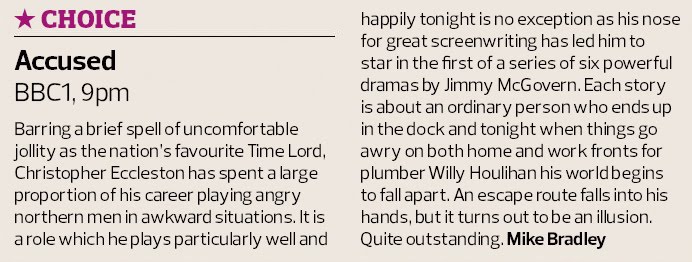
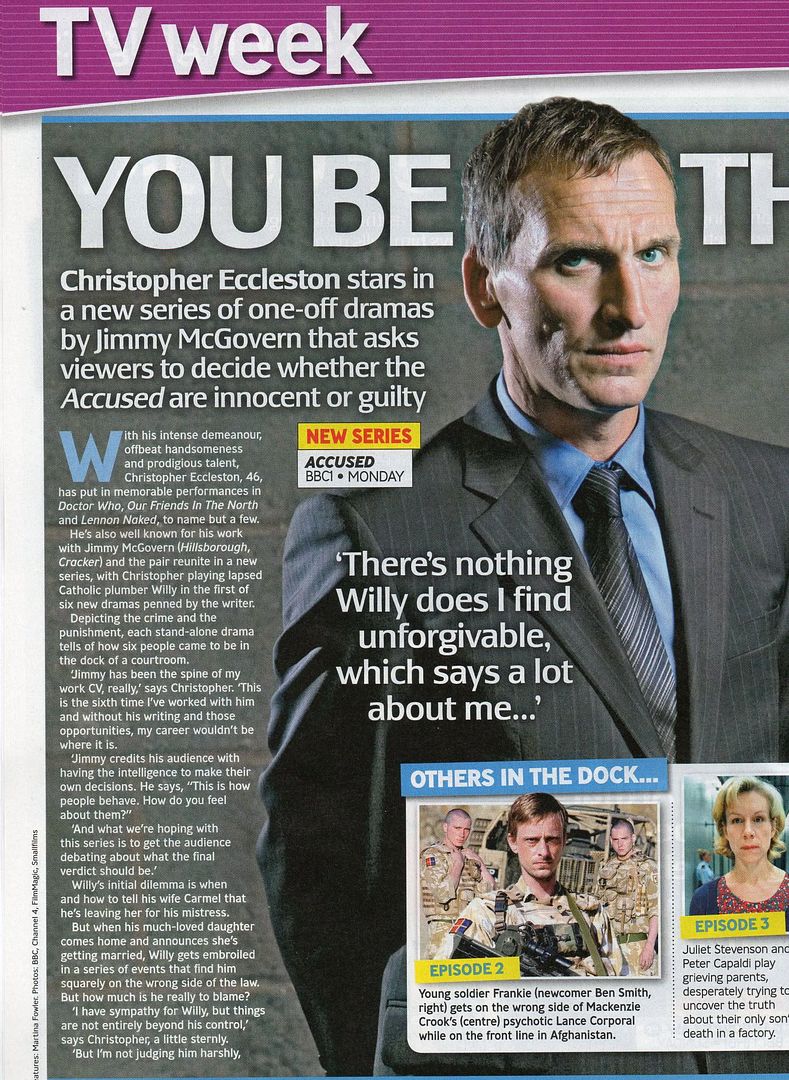
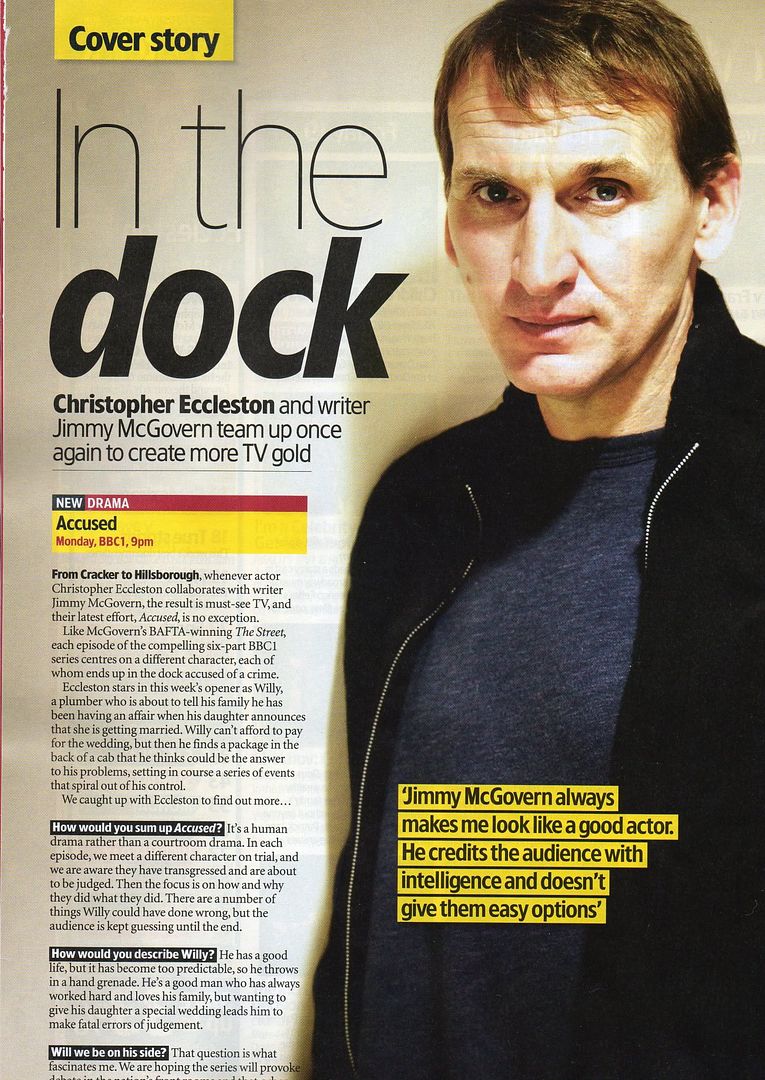
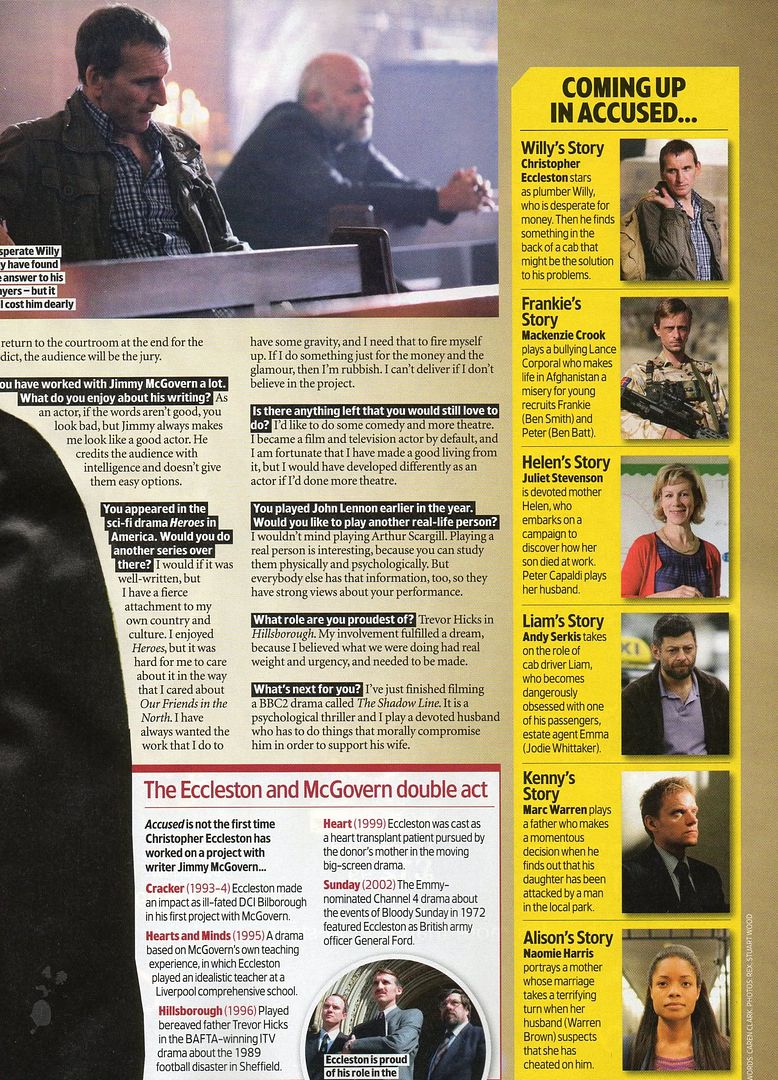
Therefore I take Christopher Eccleston's praises with a pinch of salt. And it actually helps not to over-react when indeed the miracle doesn't happen. It's good TV, but it's nowhere near genius level. The polemics Jimmy McGovern and Christopher Eccleston engage in regarding 'Accused' and the first episode of the series, 'Willy's Story', are peculiarly misleading. Imagine if you analysed 'Hamlet' and you emphasised that the main points of the play are the deficiencies of monarchy and weather in Scandinavia.
So the main problem is actually not with the episode, but with namely the pre-formed expectations. And the normal reaction is to seek explanations and, indeed, discover faults and failings. 'Is this truly realistic?', 'Is this plausible?' Quite unfortunate in the case of this 'Accused' story. And aren't those so called faults and problems a tad (as in, pink-elephant-level) obvious?
Speaking of the narrative, it might be 'truthful' in its form, the technical side. What it says, however, is far more than just a pre-fab message - because the truth is a closed system that can't survive inversion or conscious/subconscious misinterpretation. This is not pseudo-documentary social realism. This is sandbox realism of McGovern. It does not take a slice of reality and present it as a generalised example, but instead concentrates reality and out of that constructs events and characters. This construction in most blatant form can for example manifest as plot ruling over everything else. When it's more elaborate, it becomes proper engaging television where you follow the characters.
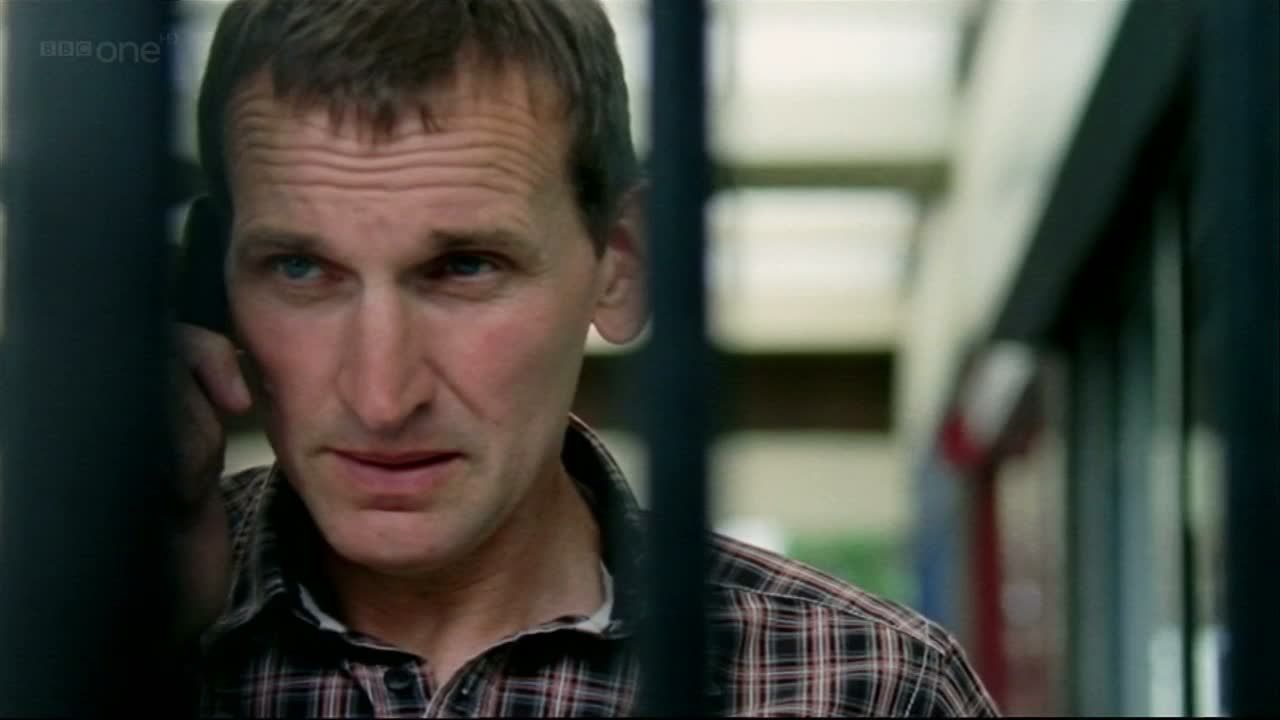
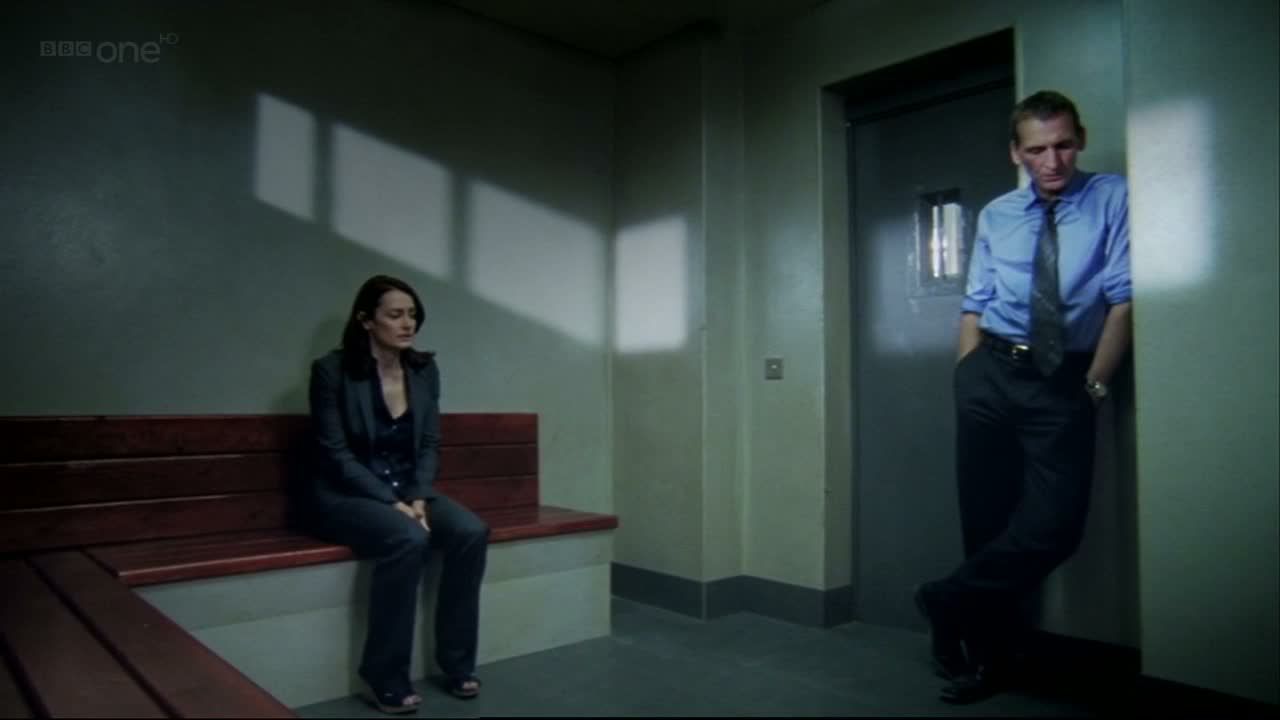
And that 'Willy's Story' certainly is. On the first viewing, I felt like I was held up by my shirtfront for the entire hour and I can only wish more dramas managed the same. It took me some rewatching to actually get the episode though, and the process I went through was exactly that of casting away the proposed framing and forgetting all the context, and simply looking at it as a self-contained film. Film that is absolutely valid and not just pontification.
Which brings us to said problems. Probably it's for the best that not everyone can say 'yes, it does happen' out of their experience. But those who can, will never see 'Willy's Story' as sci-fi. There comes indeed a period in a man's life where one feels as if one lives in a western, where - while positive outcome is of course still theoretically possible - one is extra-capable of making decisions that in the end perfectly derail one's - and the family's - life. And I challenge you to find a person who hasn't experienced a "So have you been to Thailand"-moment! Add pet peeves, pride - of a man, a worker, a breadwinner, a father. That's Willy Houlihan for you. And that's why I find him interesting, not ugly, as a person (just like David Stephens and Major West, so I'm not exactly overstraining here).
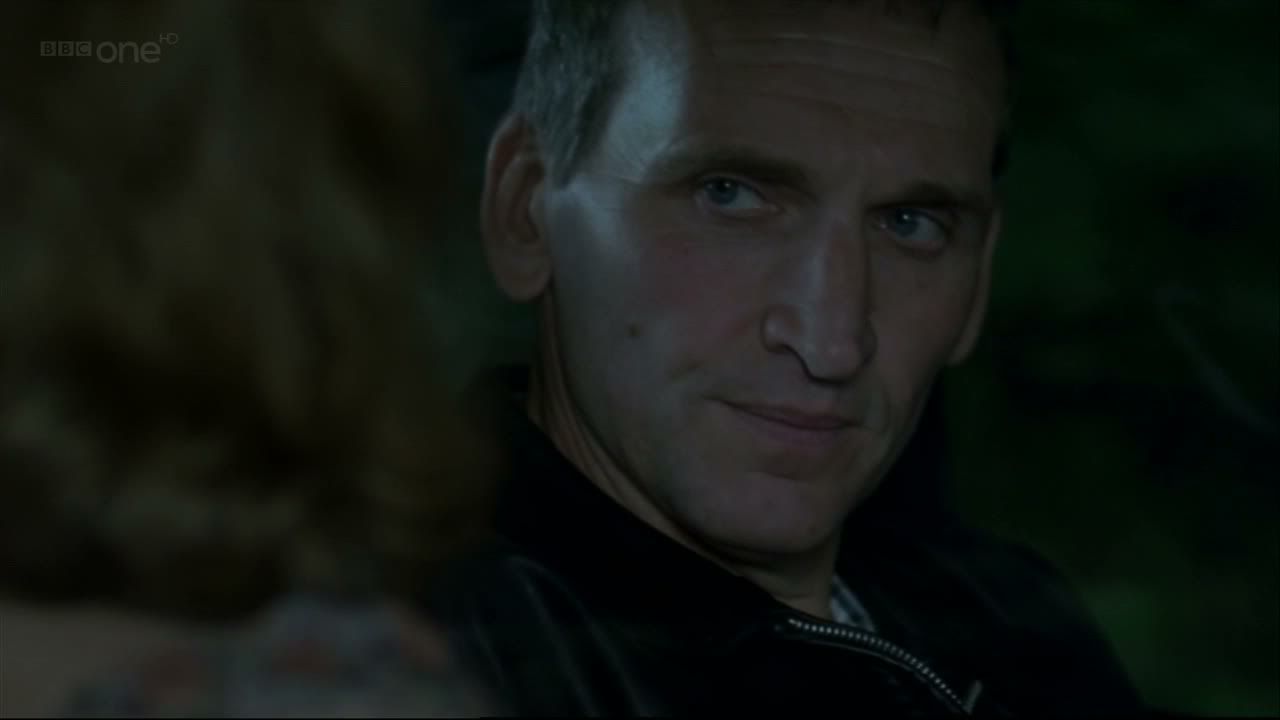
The priest scene - it is staged to suggest something supernatural, but any dedicated priest with a long career is a good psychologist. There is of course a certain 'magical' atmosphere, as if reality was suspended - there's for example a notable change in how Willy talks too. The priest can probably be seen as a 'projection of Willy's doubts' - if the framing is put aside. It leaves the discovery of the money which is one thing I'm uncertain about - but mostly because it's as if emulating a certain film by Danny Boyle, especially the stylised cut-aways to the baddies. So, while even weirder things happen in everyday life, I suppose I wish there was another way Willy could have come across the loot. Story progresses through a step-system of decisions, and it could have allowed a more proactive event without losing the subtlety or the gradual build-up (that are essential to prepare the stage for the twist that comes later).
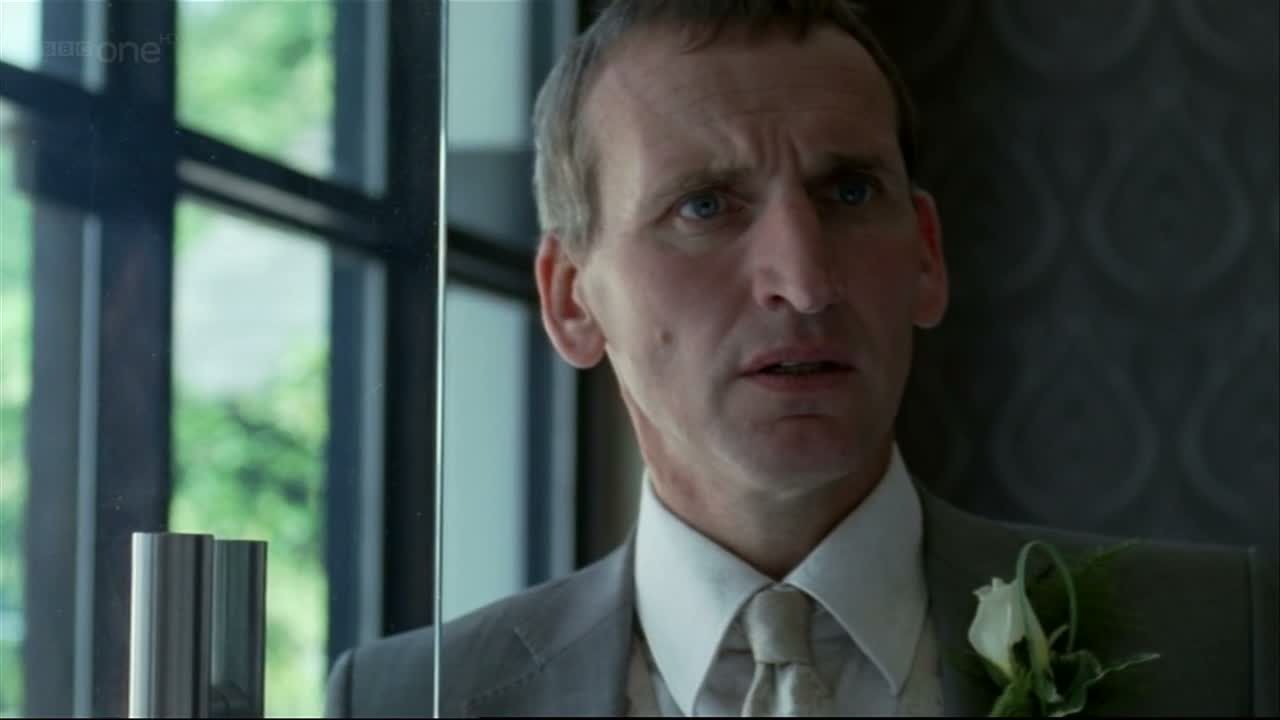
Overall, apart from a slight dip towards the middle of the episode, it's very well paced. While it could do with some breathing space, the important thing is the stability of how the story is unrolled. The authors suggest that the driving force is that you don't know which crime it was that put Willy in the dock (he even drops the cigarette outside the casino: McGovern illustrating the point Willy made earlier, that's dark humour for you). What added extra weight and poignancy to the film for me, was how by learning more about Willy, I started to understand better and better what it means for him to be in that situation, being the accused. And the end was perfect.
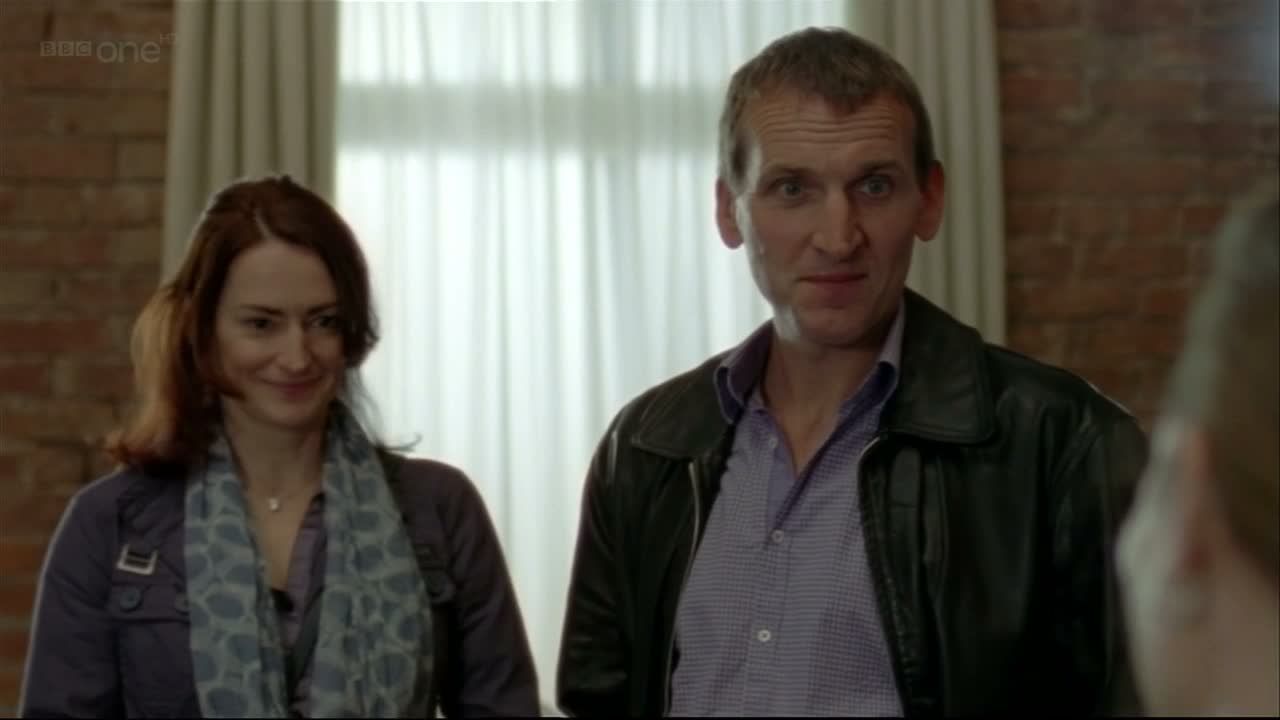
While there might be some issues with the story, it's a great portrayal of the character by Christopher Eccleston. In my eyes, his second best film of the last five years. And namely this performance and my willingness to allow the film its quirks that makes it work. The middle-class approach is, ironically, the one that benefits this wannabe-gritty drama.
P.S.: Having watched the whole series, I must add: 'Willy's Story' was the only one where the sentence felt native in the story universe. In the rest of the episodes, the justice or injustice took the form of a tacked-on extra point, sometimes quite ridiculous. Structure-, dialogues- and dimensions-wise, Eccleston's episode was also one of the, if not simply, the, strongest.
2010-11-26